

 Image 1 of 1
Details
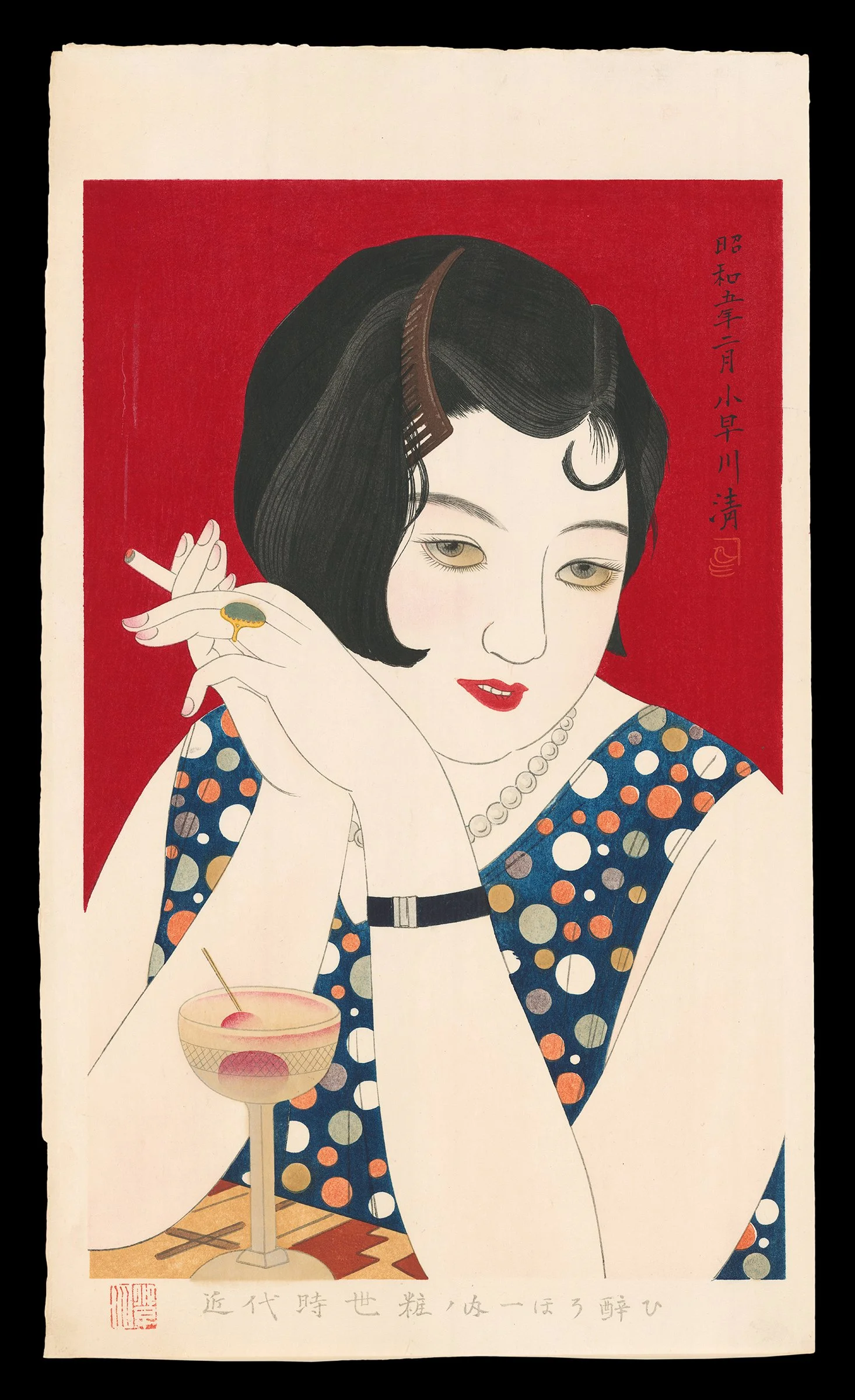
Kobayakawa Kiyoshi’s Tipsy stands among the most iconic images of feminine modernity produced in early Shōwa Japan. Set against a striking field of saturated crimson, a fashionable young woman leans delicately upon crossed arms, cigarette poised gracefully between elongated fingers while a cocktail glass rests before her. Her sharply bobbed hair, sleeveless patterned dress, jeweled ring, and softly lowered gaze immediately situate her within the cosmopolitan culture of Tokyo at the height of the interwar years. Every element of the composition evokes the atmosphere of jazz cafés, dance halls, cocktail lounges, and department store modernity that flourished throughout the city during the late 1920s and early 1930s.
The print belongs to Kiyoshi’s celebrated series Modern Styles of Women, a body of work devoted to capturing the changing appearance and psychology of contemporary women. Unlike earlier bijin-ga traditions that emphasized timeless ideals of feminine beauty, Tipsy embraces the visual language of urban consumer culture and international fashion. The woman’s Western-style attire and cocktail glass reflect the profound influence of American and European trends entering Japan during the period, particularly through cinema, advertising, jazz music, and café society. Yet Kiyoshi avoids caricature or spectacle. Rather than presenting the modern girl merely as a fashionable curiosity, he imbues her with introspection and emotional complexity.
The bold red background intensifies the composition’s psychological charge. Detached from any specific interior, the figure appears suspended within an atmosphere of warmth, intoxication, and quiet contemplation. Her expression remains ambiguous—part languor, part distraction—as though momentarily withdrawn from the social world surrounding her. This subtle emotional distance reflects the broader tensions of interwar Japan itself, when newfound freedoms and consumer pleasures coexisted alongside economic instability, political unease, and increasing social conservatism. The modern girl emerged during these years both as a celebrated emblem of cosmopolitan sophistication and as a contested symbol of shifting cultural values.
Kiyoshi’s graphic sensibility reveals the influence of both traditional woodblock design and contemporary commercial illustration. The flattened color planes, decorative patterning, and sharply controlled contours possess a distinctly modern rhythm, while the refined handling of the face and hands preserves the elegance associated with classical bijin-ga portraiture. The result is a composition that feels simultaneously intimate and theatrical, poised between personal reverie and public performance.
Connoisseur's Note
Among images of the moga produced during the early Shōwa period, Tipsy remains exceptional for its psychological sophistication and visual restraint. Kiyoshi captures not simply the outward appearance of modern femininity, but its atmosphere—the cultivated pose, the quiet fatigue beneath glamour, the fleeting pleasures of urban nightlife. The cigarette and cocktail are not incidental accessories, but carefully chosen markers of a generation shaped by imported fashions, expanding café culture, and the rapid transformation of everyday social life in Tokyo.
The print also reflects the increasingly cinematic sensibility that permeated Japanese visual culture during the late 1920s. The cropped composition and luminous red backdrop recall contemporary film close-ups and magazine illustration, media through which ideals of beauty and sophistication circulated widely among urban audiences. Kiyoshi understood the power of this new visual language and translated it masterfully into woodblock form, merging traditional craftsmanship with the sleek immediacy of modern graphic design.
Collectors have long regarded Tipsy as one of the defining masterpieces of modern Japanese printmaking precisely because of this synthesis. The work captures a fragile cultural moment in which Japan embraced cosmopolitan modernity with extraordinary intensity before the political climate of the 1930s shifted toward greater nationalism and restraint. Seen in retrospect, the figure’s introspective expression acquires additional poignancy, embodying a world of fleeting pleasures already shadowed by uncertainty.
The extraordinary economy of the composition contributes greatly to its enduring power. Kiyoshi eliminates all unnecessary detail, allowing gesture, color, and expression to carry the emotional weight of the image. The crimson background seems to vibrate softly around the figure, heightening the sensation of warmth and intoxication while isolating her within her own thoughts. The result is less a portrait than a mood suspended in time—an image of modern urban life distilled into elegance, solitude, and quiet transience.
More prints by Kobayakawa Kiyoshi:

1932
$20,000
Odori
Kobayakawa Kiyoshi (1899–1948)
MEDIUM: Woodblock print
DATE: 1932
EDITION: 33/100
DIMENSIONS: 17 ¾ x 12 ¾ inches
CONDITION: Excellent; no problems to note
NOTE: Silver Mica Background; limited edition numeration on reverse
LITERATURE: The Female Image, pl. 196
$20,000.00