

 Image 1 of 1
Details
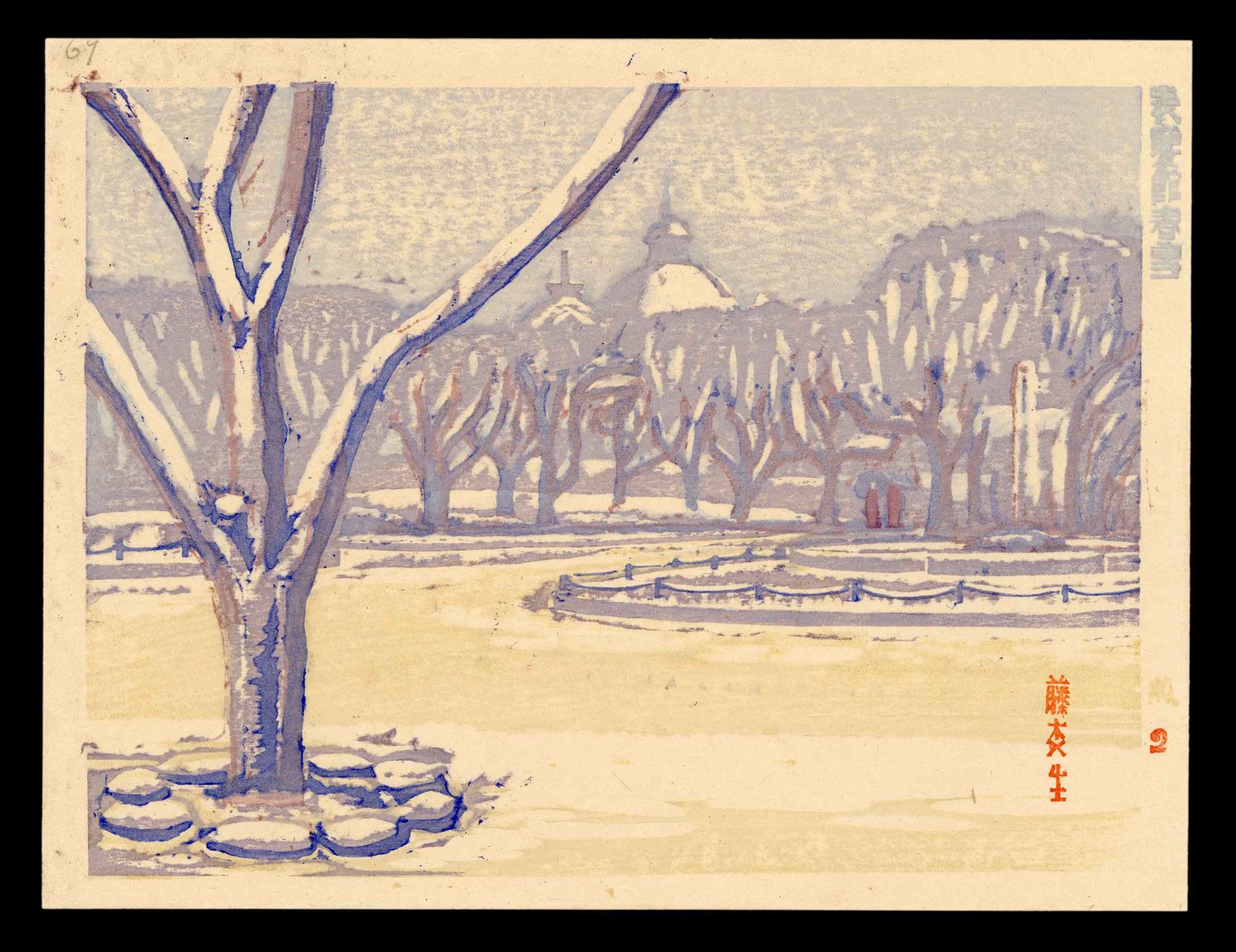
Shizuo Fujimori’s Hyokei-kan in Spring Snow transforms the modern capital into a scene of hushed stillness and atmospheric restraint. The composition is structured around the elegant silhouette of a leafless tree in the foreground, its pale trunk and branching limbs stretching across the picture plane like calligraphic strokes. Beyond it, the grounds of Ueno Park dissolve into drifting snow and misty lavender-gray tones, while the domed roof of the Hyokei-kan emerges faintly through the haze. The building appears less as architecture than as memory—partially obscured, softened by weather, and suspended within the quiet rhythm of seasonal transition.
The print demonstrates Fujimori’s extraordinary sensitivity to tonal reduction and negative space. Rather than relying upon sharply defined outlines, he allows the forms to dissolve into one another through transparent layers of color and subtle woodgrain texture. The sparse arrangement of trees, pathways, and distant figures creates a contemplative emptiness associated with Japanese aesthetic ideas of ma and mono no aware, where silence and impermanence become central expressive elements. Though modern Tokyo rapidly expanded during the early Shōwa era, Fujimori reveals a city still capable of moments of introspection and seasonal poetry.
Connoisseur's Note
The Hyokei-kan itself carried important cultural associations within Tokyo’s modern identity. Originally constructed in the Meiji period as a Western-style ceremonial building within the grounds of the Tokyo National Museum, it symbolized Japan’s early engagement with European architectural forms and cosmopolitan aspirations. By the late 1920s and early 1930s, such buildings had become layered historical markers within an increasingly modernized urban landscape, linking the ambitions of the Meiji era with the reconstructed metropolis emerging after the earthquake.
Fujimori’s handling of the subject is notable for its rejection of spectacle. Whereas many artists depicting the rebuilt capital emphasized electrified streets, transportation networks, or industrial dynamism, this work instead dwells upon atmosphere, memory, and quiet endurance. The restrained palette and near-monochromatic harmony reveal an artist deeply attentive to emotional nuance rather than descriptive realism. In this sense, the print occupies a distinctive place within early modern creative printmaking, balancing modern urban consciousness with an enduring sensitivity to season, transience, and contemplative space.
Only fifty impressions of each design in the One Hundred Views of New Tokyo series were produced, making surviving examples increasingly scarce today. The limited production reflects the highly artisanal nature of the project and the independent ethos central to the Sosaku Hanga movement. Prints from the series are now regarded among the most important visual records of Tokyo’s reconstruction during the interwar period.
More prints by Shizuo Fujimori:
1934
$1,500
Imperial University (Waseda University) in Autumn Light
Shizuo Fujimori (1891–1943)
SERIES: Twelve Views of Greater Tokyo
MEDIUM: Woodblock print
DATE: 1934
DIMENSIONS: 10 ¼ x 13 1/2 inches
CONDITION: Excellent, no problems to note
$1,500.00