

 Image 1 of 1
Details
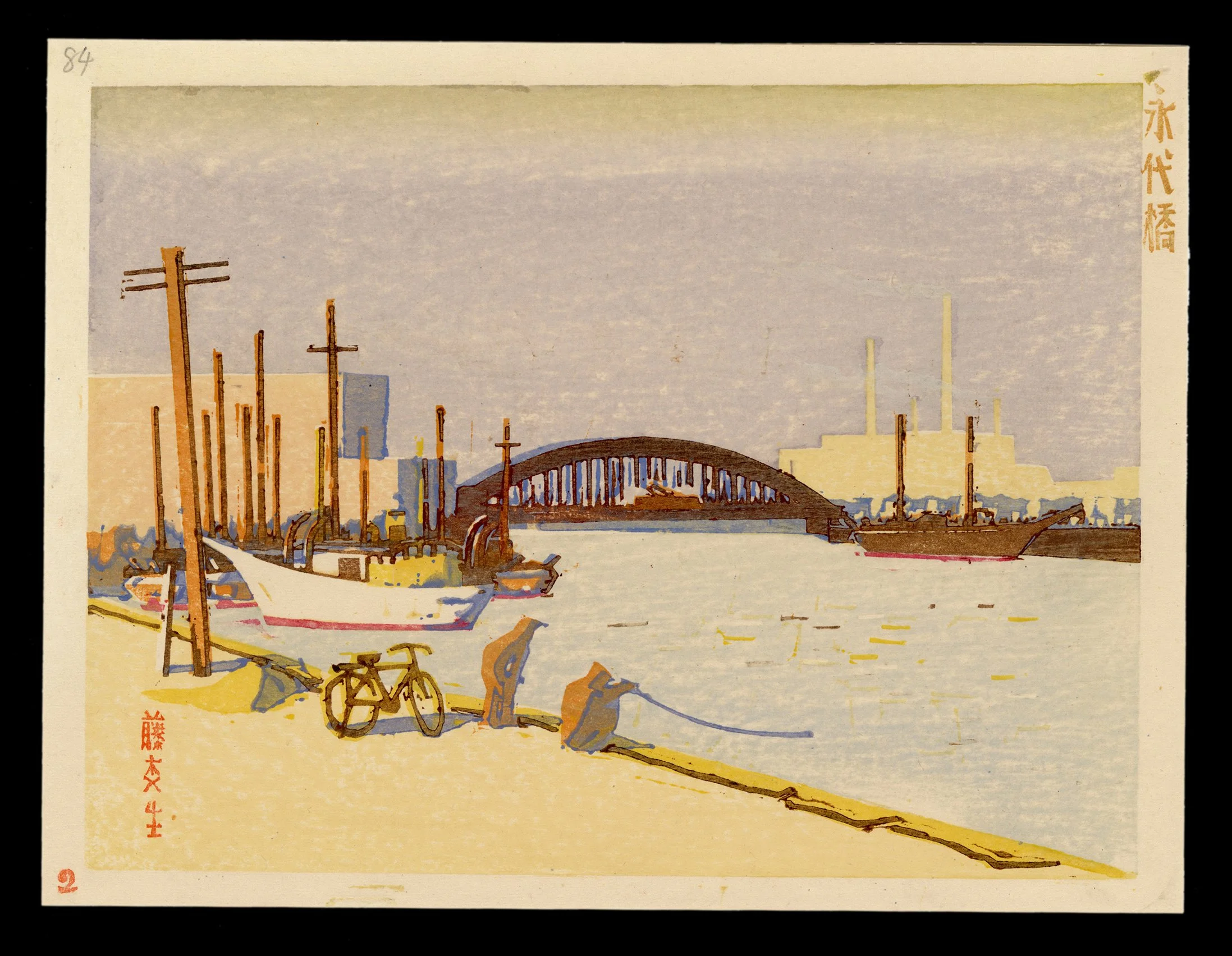
In Eitai Bridge, Shizuo Fujimori presents the modern city not through crowded boulevards or theatrical urban spectacle, but through the quiet geometry of Tokyo’s working waterfront. Fishing boats and industrial barges rest along the riverbank beneath a pale lavender sky, while the steel arch of Eitai Bridge stretches calmly across the distance. Smokestacks and factory forms emerge faintly beyond the river, their softened silhouettes suggesting a city transformed by engineering, commerce, and post-earthquake reconstruction. The composition balances industry and stillness with remarkable restraint.
Fujimori’s treatment of space is exceptionally subtle. The broad expanse of pale water occupies much of the composition, allowing the eye to move slowly between the anchored vessels, the bridge, and the distant industrial horizon. Telephone poles and mooring lines create a delicate rhythm of vertical and horizontal accents, while the solitary bicycle in the foreground quietly humanizes the otherwise industrial landscape. The reduced palette of muted violets, creams, ochres, and soft blues lends the work an atmosphere of contemplative calm rather than mechanical intensity. Though modern infrastructure dominates the scene, the print retains an almost lyrical serenity.
Connoisseur's Note
Eitai Bridge held profound symbolic importance within the evolving identity of modern Tokyo. Originally constructed during the Meiji period and rebuilt following the Great Kantō Earthquake, the bridge came to embody both technological progress and civic resilience. Bridges had long occupied an important place within Japanese visual culture—from ukiyo-e landscapes of Edo to modern creative printmaking—but in the early Shōwa era they acquired additional meaning as emblems of reconstruction, mobility, and urban continuity. Fujimori’s interpretation reflects this transition with notable elegance.
In this composition, Fujimori approached modernity through quiet balance and atmospheric refinement. His modern city is not overwhelming, but lived within—absorbed into the rhythms of everyday existence and seasonal light. The understated harmony of the print reveals an artist attentive to the emotional texture of urban transformation, where industrial expansion and poetic sensitivity coexist within the same visual field.
Only fifty impressions of each design in the One Hundred Views of New Tokyo series were produced, making surviving examples increasingly scarce today. The limited production reflects the highly artisanal nature of the project and the independent ethos central to the Sosaku Hanga movement. Prints from the series are now regarded among the most important visual records of Tokyo’s reconstruction during the interwar period.
More prints by Shizuo Fujimori:
1934
$1,500
Imperial University (Waseda University) in Autumn Light
Shizuo Fujimori (1891–1943)
SERIES: Twelve Views of Greater Tokyo
MEDIUM: Woodblock print
DATE: 1934
DIMENSIONS: 10 ¼ x 13 1/2 inches
CONDITION: Excellent, no problems to note
$1,500.00