

 Image 1 of 1
Details
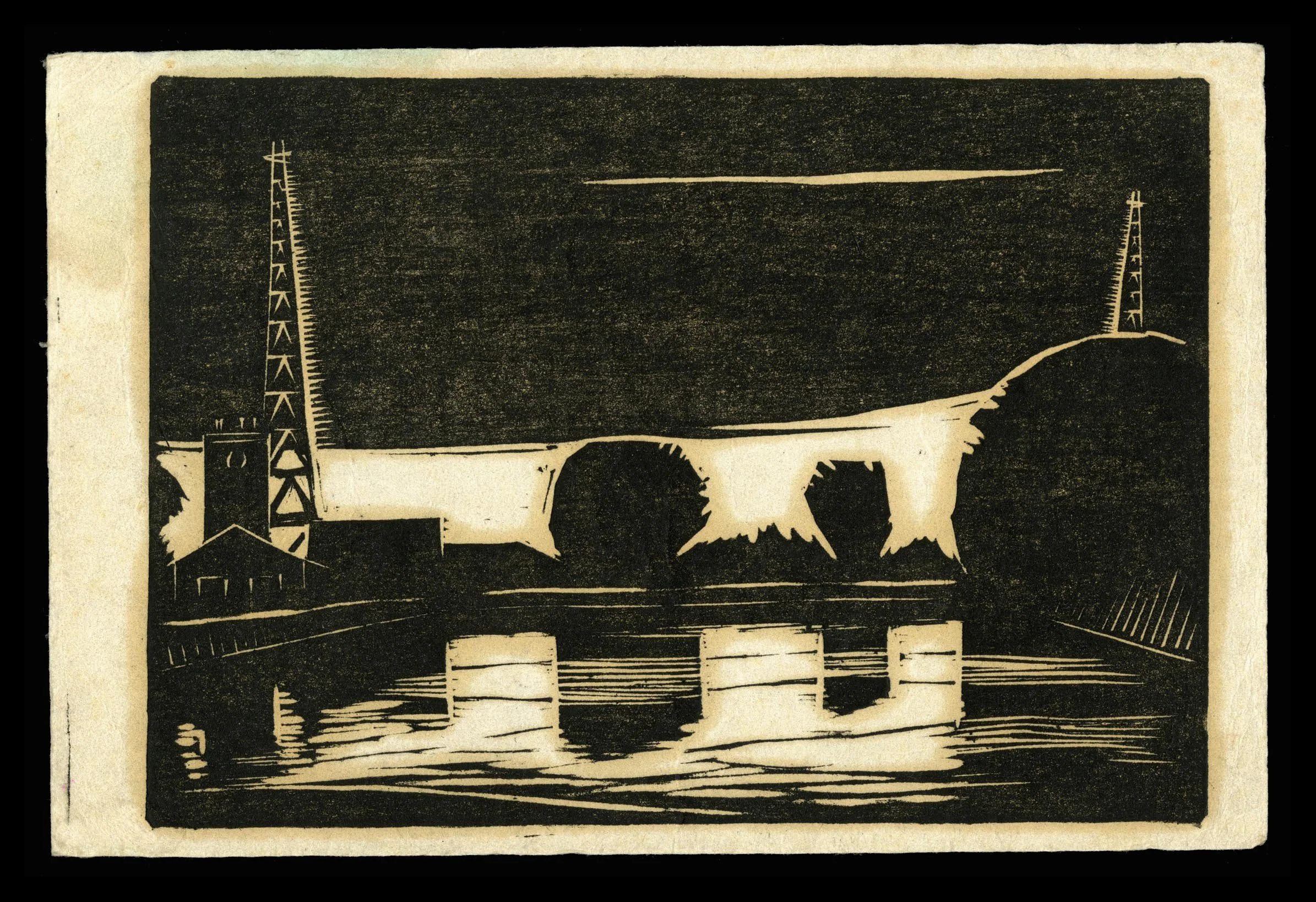
Executed in 1925, Radio Wave Towers reveals Tomoo Inagaki’s early fascination with the emerging technological landscape of modern Japan. The composition depicts two towering transmission structures rising against a darkened sky, their angular skeletal forms reflected in a quiet pool of water below. Stark contrasts between black and untouched paper transform the industrial scene into an almost abstract orchestration of geometry, reflection, and atmosphere.
Created only two years after the devastation of the Great Kantō Earthquake, the print reflects a Tokyo rapidly rebuilding itself through steel, electricity, communication networks, and modern infrastructure. Radio towers in particular carried potent symbolic meaning during the 1920s. They represented not merely technological advancement, but the invisible circulation of information, entertainment, music, and mass culture that increasingly shaped urban identity. The modern metropolis was no longer experienced solely through architecture and streets, but through unseen waves transmitting voices, news, and popular culture across the city.
Unlike the romanticized landscapes often associated with shin hanga, Inagaki’s print focuses unapologetically on industrial modernity. The subject is not nostalgic Japan, but the contemporary urban environment itself. The sparse composition heightens this effect. Empty black sky surrounds the towers, while the reflective water creates a subtle tension between solidity and dissolution. The structures appear monumental yet isolated, standing like sentinels of a newly electrified age.
The graphic boldness of the carving reveals Inagaki’s engagement with modernist aesthetics emerging internationally during the 1920s. The simplified forms, dramatic negative space, and emphasis on stark design align the print with broader avant-garde currents while remaining firmly rooted within the handmade ethos of sōsaku hanga. Every carved line retains the physical presence of the artist’s hand, emphasizing personal expression over polished commercial finish.
Connoisseur's Note
Radio Wave Towers stands as an extraordinarily important example of early urban sōsaku hanga. Before Inagaki became celebrated for his highly stylized depictions of cats and animals, he explored themes of modern infrastructure and metropolitan transformation with remarkable originality. Prints from this early experimental period are scarce and possess a raw immediacy largely absent from his later decorative works.
Particularly compelling is the psychological atmosphere created through reduction and silence. The towers rise within an almost empty nocturnal field, their reflections fractured across dark water. This sense of isolation transforms industrial architecture into something poetic and faintly existential. Inagaki does not depict the city bustling with crowds or neon spectacle; instead, he captures the quiet underlying structure of modern life itself—the hidden systems supporting the new metropolis.
The print also reflects the broader intellectual climate of Taishō and early Shōwa modernism, when artists increasingly embraced contemporary subjects previously considered unsuitable for traditional woodblock printmaking. Factories, rail stations, electrical lines, bridges, and communication towers became emblems of a transformed society negotiating the relationship between technology and identity. Inagaki approaches these themes not with celebration alone, but with contemplation, allowing industrial forms to acquire an almost meditative stillness.
More prints by Tomoo Inagaki:
1929
RESERVED
Tokyo Station in Snow
Tomoo Inagaki (1902–1980)
MEDIUM: Woodblock print
DATE: 1929
DIMENSIONS: 8 × 6 ½ inches
CONDITION: Excellent, no problems to note
NOTE: Rare early work
$950.00 <RESERVED>