

 Image 1 of 1
Details
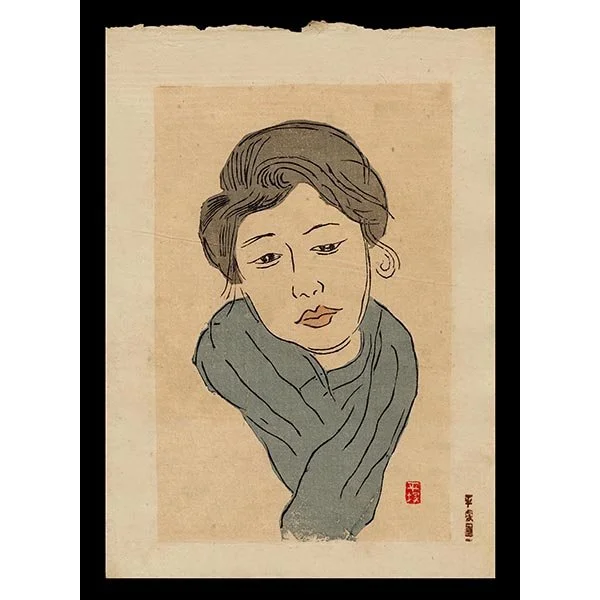
Created in 1923, Portrait of My Wife, Teruno is a deeply personal and quietly modern work by Unichi Hiratsuka, one of the central pioneers of the sōsaku hanga movement. The print depicts the artist’s wife, Teruno, likely in her late twenties or early thirties, rendered through a remarkably economical arrangement of line and muted color. Her softly tilted head, heavy-lidded gaze, and loosely draped garment create an atmosphere of intimacy and introspection, transforming a domestic portrait into an image of profound psychological presence.
Unlike the highly polished bijin imagery commonly associated with commercial woodblock publishing during the Taishō and early Shōwa years, Hiratsuka approaches the figure with deliberate simplicity. The carving is spare yet expressive, allowing each contour to retain the immediacy of the artist’s hand. Teruno’s face emerges not through decorative refinement, but through subtle asymmetry and emotional nuance. The restrained palette of pale flesh tones and cool blue-grey drapery further emphasizes the contemplative quietness of the composition.
As an early sōsaku hanga work, the print reflects the movement’s commitment to artistic self-expression and direct authorship. Hiratsuka believed the artist should design, carve, and print the work independently, rejecting the collaborative production systems of earlier ukiyo-e traditions. This philosophy imbues the portrait with an unmistakable sense of individuality. The visible directness of the line, the open areas of paper, and the absence of elaborate embellishment all contribute to a feeling of immediacy rarely found in commercial portraiture of the period.
Though intimate in scale, the image also reflects broader cultural shifts unfolding in Japan during the early 1920s. Teruno’s appearance embodies aspects of the emerging modern woman—not through overt fashion or urban spectacle, but through psychological self-possession and naturalism. The portrait belongs to a moment when Japanese artists increasingly explored modern identity through private interior life rather than theatrical public imagery. In this sense, Hiratsuka’s depiction of his wife feels strikingly contemporary, balancing tenderness with an understated modern sensibility.
Connoisseur's Note
Portrait of My Wife, Teruno stands among the most compelling examples of early sōsaku hanga portraiture, revealing Hiratsuka’s extraordinary ability to convey emotional depth through radical simplicity. While later generations often associate modern Japanese printmaking with bold graphic experimentation or urban imagery, works such as this demonstrate that modernism within sōsaku hanga could also manifest through restraint, intimacy, and psychological realism.
The portrait occupies an important position within Hiratsuka’s early career. During the 1920s, the artist was actively shaping the visual and philosophical direction of the creative print movement, seeking to establish woodblock printing as a fully modern fine art medium rather than a commercial craft tradition. His emphasis on direct carving and expressive line connected Japanese printmaking to broader international modernist currents while remaining rooted in distinctly Japanese ideas of balance, atmosphere, and material sensitivity.
More prints by Unichi Hiratsuka:
1923
$1,000
Portrait of my Wife, Teruno, 1923
Unichi Hiratsuka (1895–1997)
MEDIUM: Woodblock print
DATE: 1923
DIMENSIONS: 11 ¾ x 8 ½ inches
CONDITION: Excellent, no problems to note
NOTE: Rare early work
LITERATURE: Hiratsuka: Modern Master, pl. 5
$1,000.00