

 Image 1 of 1
Details
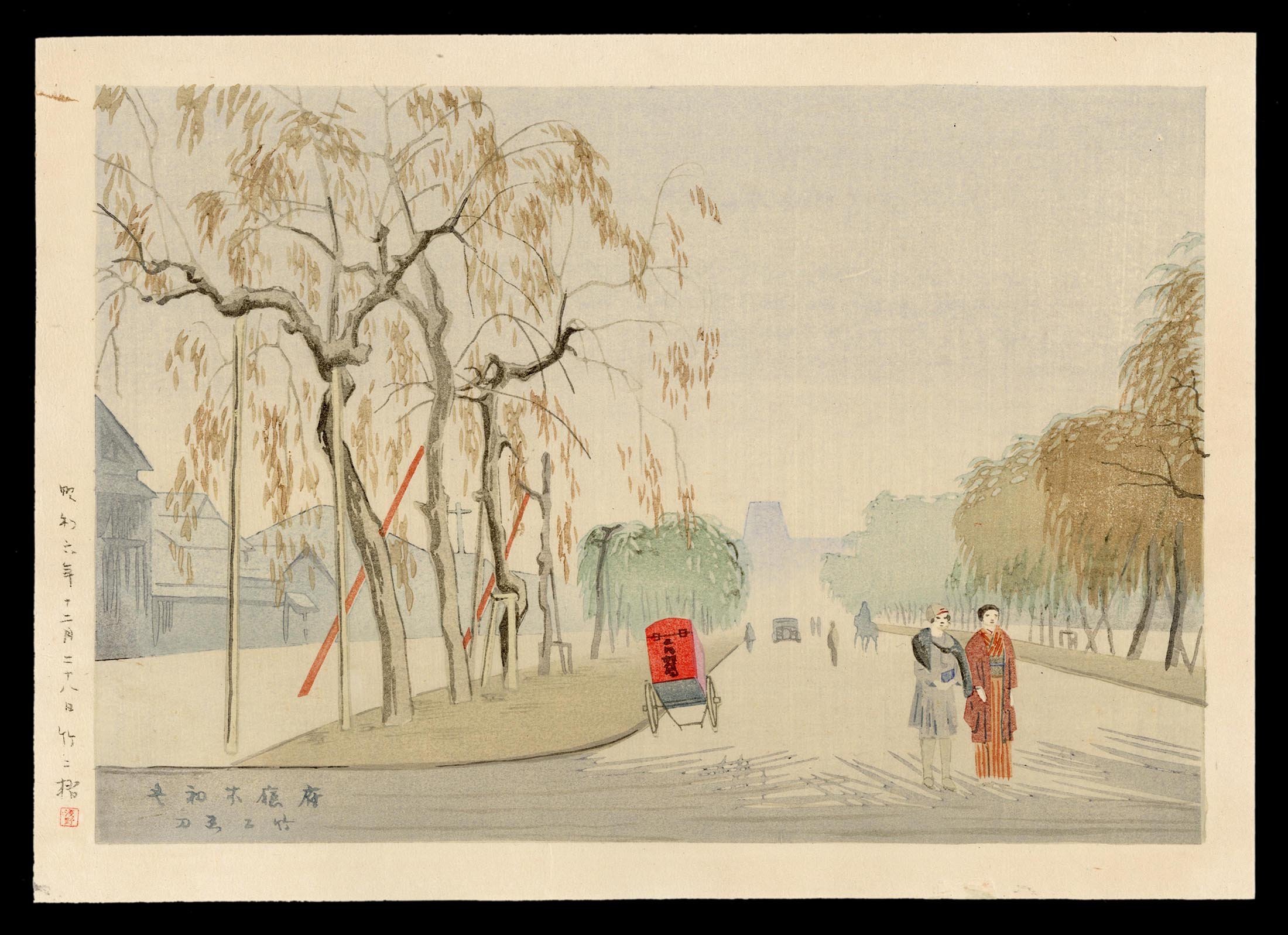
In Early Winter in Front of the Prefectural Office, Takeji Asano transforms an ordinary urban thoroughfare into a remarkably sensitive portrait of Japan in transition. The long avenue recedes beneath a pale, almost silvery winter sky, its perspective softened by atmospheric haze. Rows of willows, their remaining leaves rendered in muted ochre and green, frame the roadway and establish the quiet, slightly melancholy character of the season.
Yet within this subdued setting Asano introduces telling signs of a rapidly changing society. Most immediately striking are the two young women walking together in the right foreground. Their fashionable appearance identifies them with the moga, or “modern girl,” a defining figure of Japanese urban culture during the late Taishō and early Shōwa periods. With their Western-influenced hairstyles and stylish dress, these two women bring a distinctly cosmopolitan note to the otherwise restrained streetscape. Their placement prominently in the foreground is particularly effective: rather than treating modernization as an abstract idea, Asano gives it human form.
The road behind them offers an equally fascinating catalogue of contemporary life. Modern automobiles travel along the same avenue as figures on horseback and traditional hand-carried or human-powered carts, while a rickshaw occupies the middle foreground. The juxtaposition seems almost incidental, which is precisely what makes it so compelling. Asano records a moment when these very different forms of transportation could still naturally inhabit the same urban space. Mechanized modernity has arrived, but it has not yet displaced the rhythms and conveyances of an earlier Japan.
The print's restrained palette enhances this sense of suspended time. Soft greys, pale greens, ochres, and diluted browns dominate the composition, interrupted by carefully placed accents of red—the rickshaw canopy, the women's clothing, and the angled supports among the trees. These warmer passages animate the otherwise misty scene without disturbing its wintry stillness.
Connoisseur's Note
Asano's finest landscape prints often derive their strength not from dramatic scenery but from an acute sensitivity to atmosphere and the poetry of everyday observation. Early Winter in Front of the Prefectural Office is especially appealing in this respect. The bare and drooping willows, expansive sky, and hazy recession of the avenue establish a lyrical seasonal mood, while the small human details quietly locate the scene within a precise cultural moment.
The two moga are particularly significant. Walking confidently along the broad avenue in fashionable attire, they embody the new urban woman who had become an emblem of Japanese modernity during the 1920s and early 1930s. Their presence, alongside automobiles, horseback riders, rickshaws, and hand-carried carts, turns what might initially appear to be a tranquil winter landscape into something richer: a visual record of a society negotiating the space between inherited custom and modern metropolitan life.
Asano does not dramatize this transformation or impose judgment upon it. Instead, old and new simply share the road. That quiet coexistence is perhaps the print's most compelling quality—and one that gives this seemingly modest street scene unusual historical resonance.
More prints by Takeji Asano:
Takeji Asano
1965
$2,500
Give Me Eyes
Takeji Asano (1900-1999)
MEDIUM: Woodblock Print
DATE: 1965
DIMENSIONS: 21 x 16 inches
CONDITION: Excellent, no problems to note
$2,500.00
Contact us to purchase