

 Image 1 of 1
Details
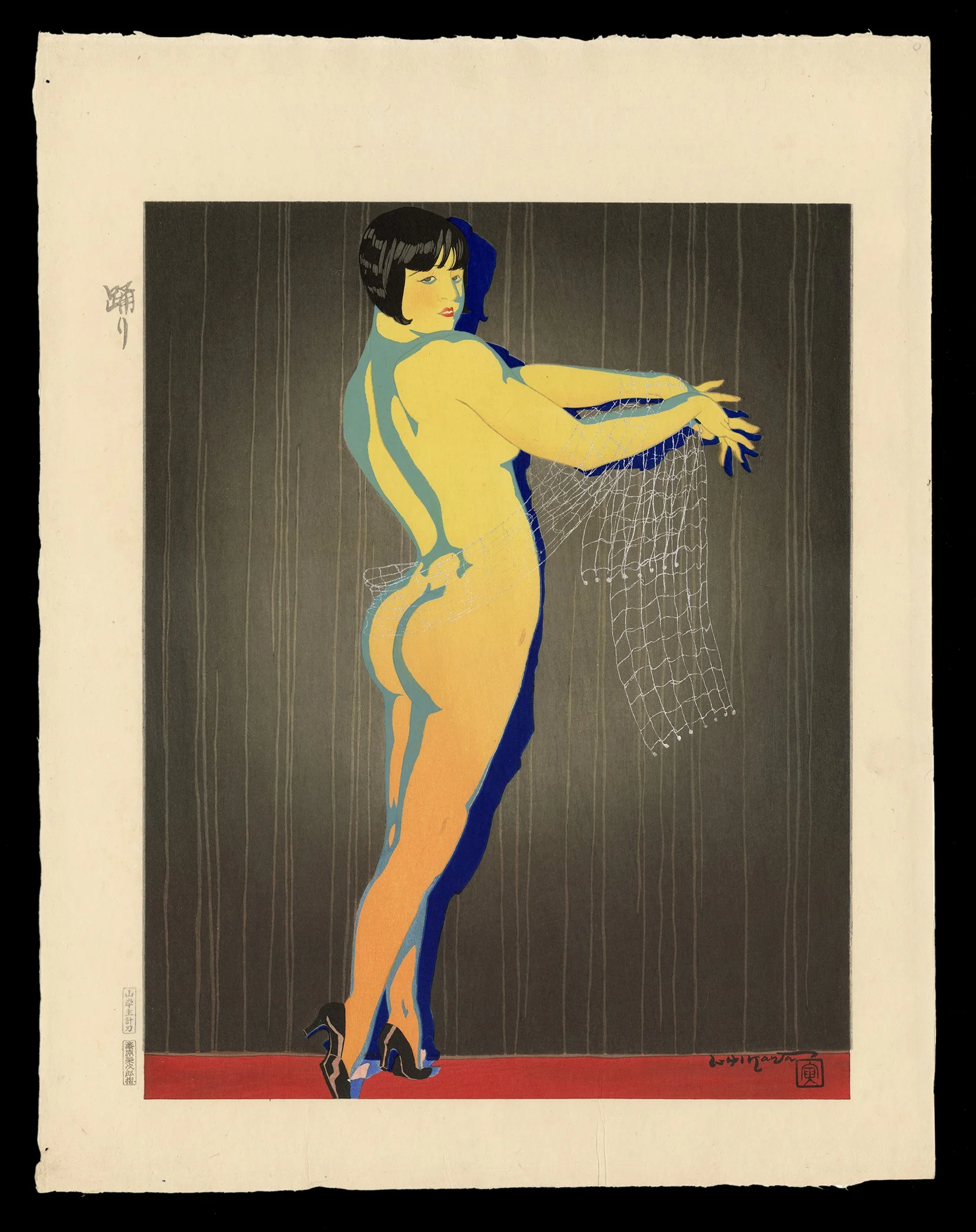
Ishikawa Toraji’s Dance is among the most daring and sophisticated explorations of modern femininity produced in Japanese printmaking during the 1930s. A nude dancer stands poised upon the tips of elegant black heels, her body twisting gently as translucent fabric slips from her arms in a gesture balanced between theatrical performance and private revelation. The figure’s sharply cut bob hairstyle, elongated limbs, and stylized pose situate the work firmly within the visual culture of cosmopolitan modernity that flourished in Japan during the early Shōwa period. Against a subdued vertically striated ground, the dancer appears simultaneously sculptural and ephemeral, illuminated by striking blue shadows that contour the body with dramatic theatricality.
Created in 1935, the print reflects the fascination with cabaret culture, revue theater, and Western-style dance that had transformed urban entertainment throughout Tokyo and Osaka during the preceding decade. Dance halls, cafés, and stage revues introduced new ideals of bodily movement and self-presentation influenced by European and American performance culture. Toraji captures this atmosphere with remarkable refinement. Unlike many earlier bijin-ga images that emphasized passive beauty, Dance presents the female body as active, modern, and consciously performative. The dancer confronts the viewer with poised self-awareness, embodying a generation increasingly shaped by cinema, jazz culture, fashion illustration, and international aesthetics.
The work reveals the growing influence of Art Deco design and modern graphic abstraction upon Japanese printmaking. Toraji reduces the composition to a carefully orchestrated interplay of line, silhouette, and color contrast. The cool blue shadow cast along the dancer’s body introduces a bold stylization uncommon in traditional bijin-ga, while the vertically striated background recalls stage curtains or theatrical lighting. The resulting composition feels both highly modern and psychologically restrained, balancing sensuality with remarkable compositional control.
The print also emerged during a moment of increasing cultural tension within Japan. By the mid-1930s, the atmosphere of experimentation and cosmopolitan freedom associated with urban leisure culture was beginning to encounter growing nationalism and social conservatism. Works such as Dance therefore preserve a fleeting vision of artistic openness and bodily liberation at a moment when public expressions of modern pleasure were becoming increasingly scrutinized. Toraji does not present the dancer as scandalous or overtly provocative; rather, she appears composed, elegant, and entirely self-possessed, embodying modernity through confidence and cultivated theatricality.
Connoisseur's Note
Among Ishikawa Toraji’s most celebrated modern figure compositions, Dance occupies a singular position for its synthesis of Japanese printmaking technique and international modernist aesthetics. The work demonstrates Toraji’s extraordinary understanding of the human figure not merely as anatomical form, but as rhythm, silhouette, and movement. Every contour of the dancer’s body contributes to the composition’s visual cadence, from the delicate extension of the fingers to the subtle tension created by the raised heels balancing upon the red stage-like floor.
The print belongs to a broader international moment in which artists across Europe, America, and Japan explored the modern female body through the languages of dance, cabaret, and performance. During the 1920s and 1930s, images of dancers became powerful symbols of liberation, spectacle, and urban sophistication. Yet Toraji’s interpretation remains distinctively restrained compared to many contemporary Western depictions. Rather than emphasizing excess or overt eroticism, he approaches the subject with an elegance shaped by clarity, balance, and emotional reserve.
Collectors particularly prize Dance for its extraordinary visual refinement and rarity in strong impressions. This example survives in excellent condition, preserving the luminous tonal contrasts and subtle color relationships essential to the design’s theatrical atmosphere. As an early second edition printing, it retains exceptional richness and clarity while offering insight into the evolving production history of the image. Especially significant is the inclusion of the accompanying keyblock trial printing, a rare and revealing artifact that illuminates the precision of the underlying line work upon which the final composition depends.
Seen today, Dance retains an astonishing sense of immediacy. The figure appears suspended between stillness and motion, intimacy and spectacle, elegance and modern provocation. Toraji captures not simply a performer upon a stage, but the visual language of an era intoxicated by movement, urban nightlife, and the possibilities of reinvention. The result is a print of remarkable sophistication—at once theatrical, restrained, and profoundly modern.
More prints by Ishikawa Toraji:
1935
$2,000
Bored
Ishikawa Toraji (1875–1964)
SERIES: Ten Types of Female Nudes
MEDIUM: Woodblock print
DATE: 1935
DIMENSIONS: 15 x 19 inches
CONDITION: Excellent; faint soiling to margins and on the reverse
LITERATURE: The Female Image, pl. 244
NOTE: First state; silver mica background
$2,000.00