

 Image 1 of 1
Details
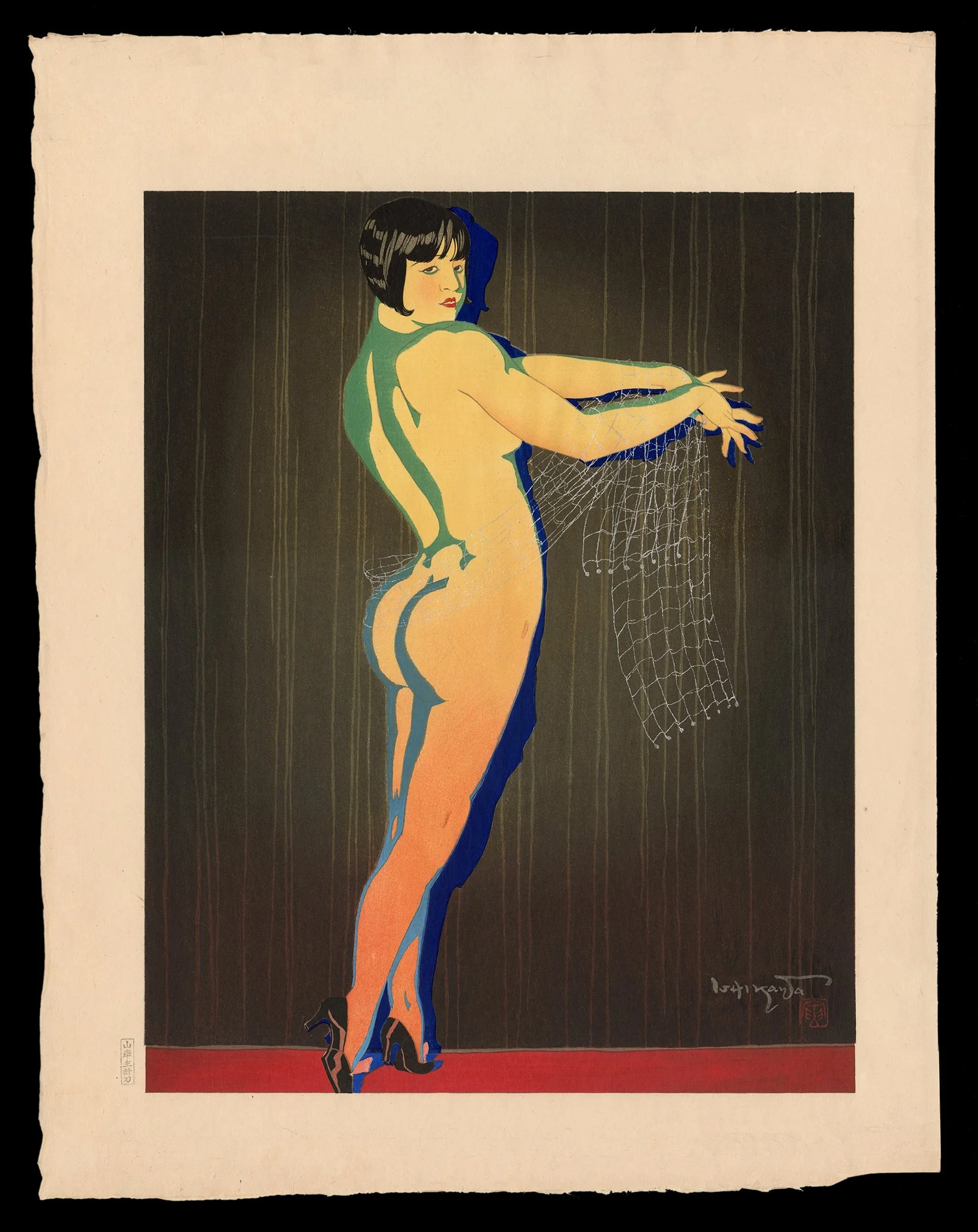
Ishikawa Toraji’s Dance stands among the most daring and visually sophisticated images of modern femininity produced in Japanese printmaking during the 1930s. A nude dancer balances delicately upon black heels, her body twisting gracefully as translucent fabric slips from her raised arms in a gesture poised between theatrical performance and private reverie. The figure’s sharply bobbed hairstyle, elongated proportions, and stylized pose place the work firmly within the cosmopolitan culture of early Shōwa modernity, where dance halls, revues, and cabaret performances introduced new ideals of movement, bodily expression, and female self-presentation into urban life.
The print was created during a period when Western-style dance had become deeply associated with sophistication and metropolitan culture in cities such as Tokyo and Osaka. Jazz cafés, cabarets, and revue theaters flourished throughout the late 1920s and early 1930s, shaping a generation fascinated by imported music, fashion, and stage performance. Toraji captures this atmosphere with extraordinary restraint. Unlike earlier bijin-ga traditions that idealized passive feminine beauty, Dance presents the female body as active, modern, and consciously performative. The dancer appears entirely self-aware, embodying the evolving visual language of cosmopolitan identity emerging throughout Japan during the decade.
Visually, the composition demonstrates Toraji’s remarkable synthesis of traditional woodblock technique and international modernist aesthetics. The cool blue shadows tracing the dancer’s body create a striking stylization reminiscent of Art Deco illustration and contemporary stage lighting, while the vertically striated background evokes the atmosphere of theater curtains or dim cabaret interiors. The dramatic contrast between the pale figure and subdued dark ground heightens the composition’s sculptural clarity, allowing the dancer to emerge with extraordinary luminosity against the surrounding stillness.
At the same time, Dance reflects the increasingly complex cultural atmosphere of mid-1930s Japan. Even as urban audiences embraced cosmopolitan entertainment and modern bodily expression, broader political and social currents were moving toward growing nationalism and conservatism. In this context, Toraji’s dancer becomes more than a performer; she embodies a fleeting cultural openness in which modernity, spectacle, and individual expression still occupied center stage within Japanese urban life. The image preserves this moment with remarkable elegance and composure rather than overt provocation.
Connoisseur's Note
Among Ishikawa Toraji’s modern figure compositions, Dance occupies a singular place for both its rarity and extraordinary formal sophistication. The work reveals Toraji’s profound understanding of the human body as rhythm, silhouette, and controlled movement. Every contour contributes to the composition’s carefully orchestrated balance, from the elegant extension of the arms to the subtle tension created by the dancer’s raised heels poised upon the red stage-like floor.
This first state impression is especially significant. Early impressions such as this preserve the full clarity and refinement of Toraji’s original conception, before subsequent printings introduced subtle shifts in tone and surface quality. Here, the richness of the pigments, precision of registration, and delicacy of the carved line remain exceptionally vivid, allowing the dramatic interplay of blue shadow, pale flesh tones, and translucent drapery to retain their intended theatrical intensity.
The accompanying keyblock trial printing further deepens the importance of the work. Such trial impressions offer rare insight into the underlying structure of Japanese print production, revealing the extraordinary precision of Toraji’s line work before the addition of layered color. Seen together, the finished print and keyblock impression illuminate the artist’s remarkable command of both draftsmanship and compositional reduction.
Collectors have long regarded Dance as one of the defining expressions of Japanese modernist printmaking during the 1930s precisely because it bridges multiple artistic worlds simultaneously. The composition reflects the influence of European Art Deco aesthetics, modern theater design, and international dance culture, yet it remains unmistakably grounded in the discipline and refinement of Japanese woodblock technique. Viewed today, the dancer appears suspended between elegance and transience, preserving the atmosphere of an era captivated by movement, performance, and the seductive possibilities of modern urban life.
More prints by Ishikawa Toraji:
1934
$3,000
Youth
Ishikawa Toraji (1875–1964)
SERIES: Ten Types of Female Nudes
MEDIUM: Woodblock print
DATE: 1934
DIMENSIONS: 19 ¼ x14 ¾ inches
CONDITION: Excellent; no problems to note
LITERATURE: The Female Image, pl. 242
NOTE: First state; accompanied with a keyblock proof; silver mica background
$3,000.00