

 Image 1 of 1
Details
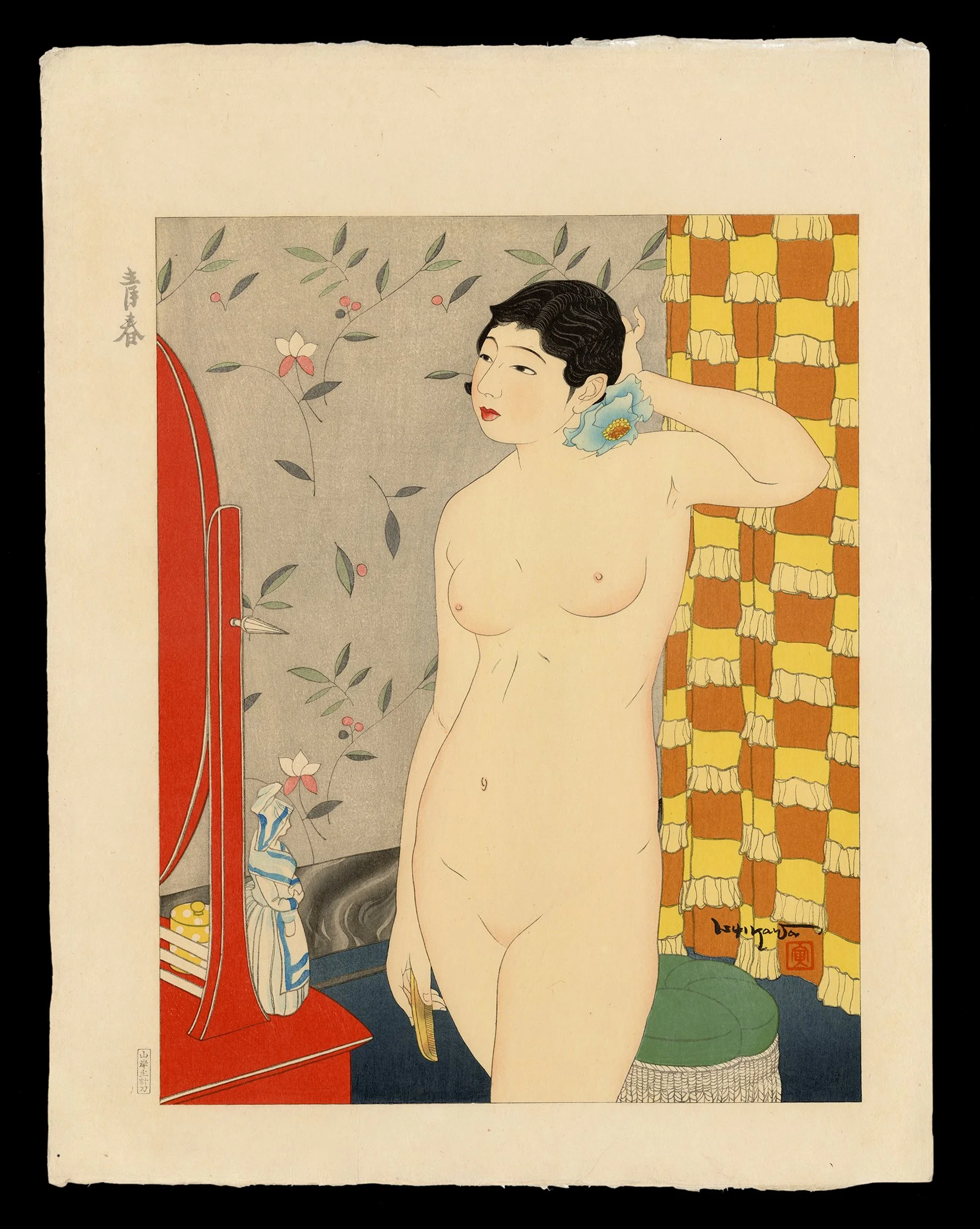
Ishikawa Toraji’s Youth presents a remarkably poised and intimate vision of modern femininity during the early Shōwa period. A nude young woman stands before a dressing mirror within an elegantly appointed interior, lightly adjusting her coiffed hair while holding a comb loosely at her side. Her softly waved hairstyle, painted lips, and refined surroundings situate the image firmly within the world of metropolitan sophistication that shaped Japanese urban culture during the 1920s and 1930s. Although unclothed, the figure projects neither theatrical sensuality nor overt provocation; instead, Toraji imbues the composition with an atmosphere of calm self-possession and cultivated privacy.
The print reflects the growing fascination with modern female identity that emerged throughout Japanese visual culture during the late Taishō and early Shōwa years. As café culture, cinema, department stores, beauty salons, and international fashion transformed urban life, artists increasingly explored women not as idealized symbols of tradition, but as active participants within a rapidly modernizing society. Toraji’s figure embodies this shift subtly. Her modern hairstyle and decorative domestic environment evoke the refined world of the moga, yet the composition remains introspective rather than performative. The viewer encounters not a public persona, but a private moment of self-awareness unfolding quietly within the interior space.
Visually, Youth demonstrates Toraji’s extraordinary command of compositional restraint and decorative balance. The luminous flesh tones of the figure are framed by richly patterned wallpaper, a striking red vanity mirror, and boldly geometric yellow drapery, all carefully orchestrated to create rhythmic tension across the composition. The interplay between the softness of the body and the angular decorative forms reflects the influence of contemporary Art Deco aesthetics while remaining deeply rooted in the discipline of Japanese woodblock design. Toraji’s use of flattened space and controlled line lends the composition a remarkable clarity and stillness.
At the same time, the work emerged during a period of increasing cultural tension in Japan. By 1934, representations of modern femininity and bodily freedom existed within a society becoming progressively more conservative and nationalistic. Toraji navigates this atmosphere with exceptional subtlety. Rather than presenting nudity as scandalous or rebellious, he frames the female body through elegance, balance, and quiet intimacy. The result is a work that preserves the atmosphere of urban modernity while maintaining an extraordinary degree of emotional restraint and refinement.
Connoisseur's Note
Among Ishikawa Toraji’s modern figure prints, Youth stands as one of his most refined explorations of feminine interiority and decorative modernism. The work demonstrates the artist’s remarkable ability to synthesize traditional Japanese compositional sensitivity with the aesthetics of international modernity emerging throughout the 1920s and 1930s. The image shares affinities with contemporary European interior portraiture and Art Deco illustration, yet remains unmistakably grounded in the subtle rhythms and spatial elegance of Japanese printmaking.
Unlike many depictions of the female nude produced internationally during the same period, Youth avoids overt dramatization. Toraji instead emphasizes atmosphere and psychological stillness. The figure’s gesture—lightly touching her hair while gazing toward the mirror—introduces a moment of quiet self-contemplation rather than display. This subtle emotional restraint gives the print its enduring sophistication, allowing intimacy to emerge gradually through posture, color, and surrounding detail.
Collectors particularly prize Youth for the extraordinary delicacy of its printing and the rarity of early impressions. This example survives in excellent condition and represents an early first state impression, preserving the subtle tonal relationships and crisp line clarity essential to the composition’s refined atmosphere. The richness of the pigments and freshness of the surface allow the decorative interplay between patterned wallpaper, geometric drapery, and luminous flesh tones to remain exceptionally vivid.
More prints by Ishikawa Toraji:
1934
$3,000
Youth
Ishikawa Toraji (1875–1964)
SERIES: Ten Types of Female Nudes
MEDIUM: Woodblock print
DATE: 1934
DIMENSIONS: 19 ¼ x14 ¾ inches
CONDITION: Excellent; no problems to note
LITERATURE: The Female Image, pl. 242
NOTE: First state; accompanied with a keyblock proof; silver mica background
$3,000.00