

 Image 1 of 1
Details
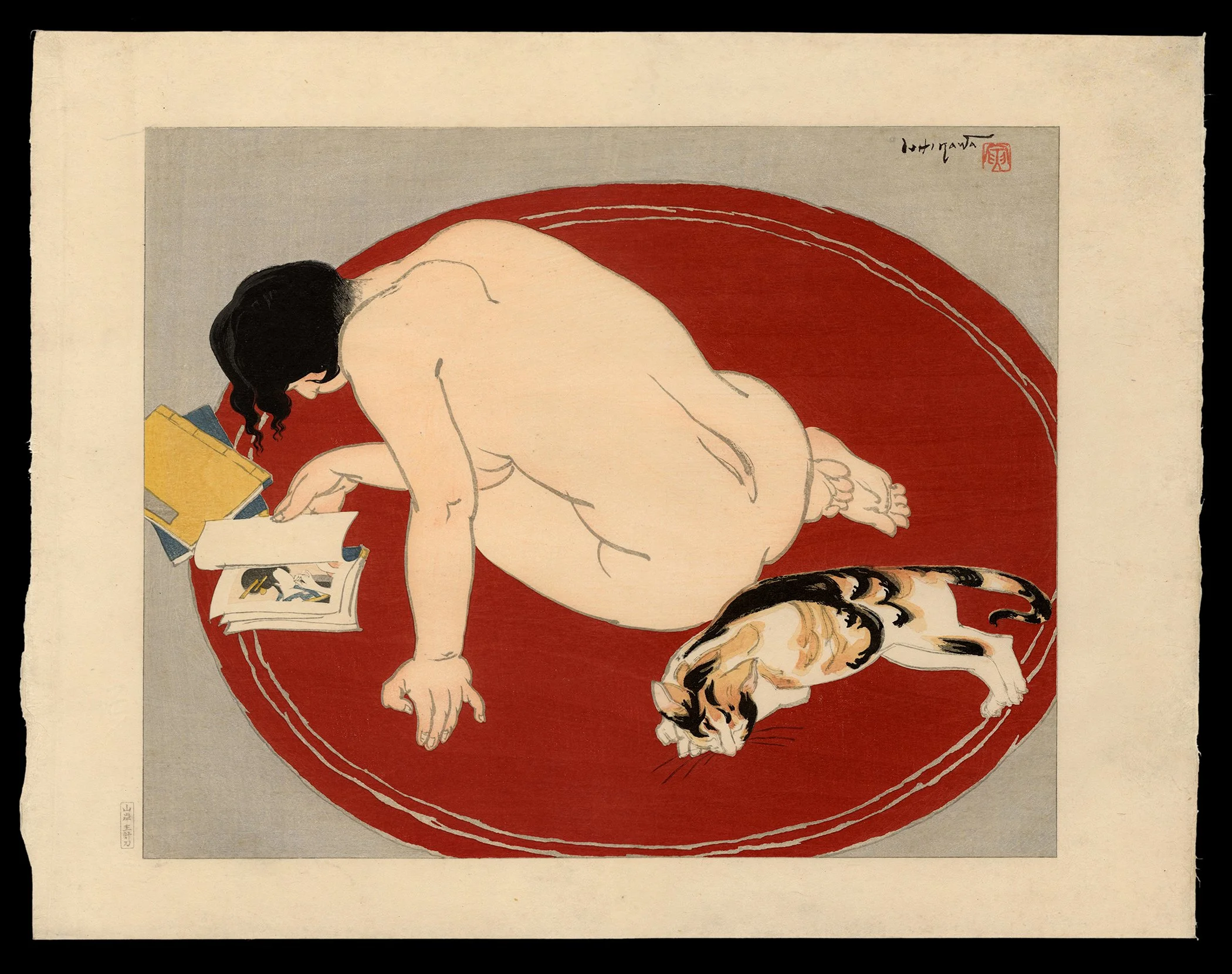
Ishikawa Toraji’s Bored is one of the most psychologically complex and visually distilled images produced in Japanese printmaking during the early Shōwa period. A nude woman reclines upon a striking vermilion circular carpet beside a lounging calico cat, her body folded inward in an attitude of languid introspection. Scattered magazines and papers lie casually nearby, suggesting an atmosphere of idle domestic leisure rather than theatrical display. Unlike many contemporary bijin-ga images that emphasize elegance or performative glamour, Toraji presents modern femininity here through stillness, emotional withdrawal, and cultivated ennui.
The composition reflects the evolving psychological sensibility of Japanese modernism during the 1930s. The title itself, Bored, is remarkably revealing. Rather than depicting beauty as passive idealization, Toraji explores interior emotional states associated with urban modern life: fatigue, detachment, restlessness, and private contemplation. Such themes resonated deeply within the broader cultural atmosphere of the period, when expanding consumer culture and metropolitan leisure introduced new forms of domestic solitude and psychological self-awareness. The figure’s loose posture and downward gaze suggest neither dramatic melancholy nor sensual invitation, but the quiet emotional ambiguity that increasingly characterized modern representations of women throughout Japan, Europe, and America during the decade.
Visually, the print demonstrates Toraji’s extraordinary ability to reduce composition to essential form. The immense red circular carpet dominates the pictorial field like an abstract stage, simultaneously anchoring the figure and flattening spatial depth. The woman and cat appear almost suspended within this vivid geometric space, their pale forms softened against the muted gray background. The cat’s relaxed posture subtly mirrors that of the figure herself, reinforcing the atmosphere of indolent stillness that permeates the composition. Toraji’s restrained line work and carefully balanced asymmetry reveal a profound understanding of both modern design principles and traditional Japanese spatial economy.
At the same time, Bored reflects broader international artistic currents circulating during the 1930s. The work shares affinities with European modernist interiors and Art Deco illustration, where themes of fashionable detachment and psychological isolation became increasingly prominent. Yet Toraji’s interpretation remains distinctly Japanese in its restraint and compositional clarity. Rather than dramatizing emotion, he allows atmosphere, posture, and silence to convey the emotional tenor of the image. The result is a work that feels simultaneously intimate and formally radical.
Connoisseur's Note
Among Ishikawa Toraji’s modern figure prints, Bored stands apart for its remarkable compositional audacity and emotional subtlety. The print reveals Toraji at the height of his powers, distilling modern experience into a nearly abstract arrangement of body, color, and empty space. The vast vermilion oval functions not merely as decorative flooring, but as a visual and psychological field around which the entire composition revolves. Against this bold geometry, the figure’s withdrawn posture acquires extraordinary poignancy.
The work belongs to a broader global fascination during the 1920s and 1930s with the psychology of modern urban life. Across painting, photography, cinema, and printmaking, artists increasingly explored solitude, boredom, and introspection as defining emotional conditions of modernity. Toraji’s contribution to this dialogue is especially refined because he approaches these themes without sentimentality or overt narrative. The figure’s emotional state remains unresolved, suspended delicately between exhaustion, contemplation, and quiet sensuality.
Collectors particularly prize Bored for the sophistication of its design and the rarity of strong impressions. This example survives in excellent condition and represents an early first state impression, preserving the subtle tonal relationships, delicate carving, and refined surface qualities essential to the composition’s visual power. The freshness of the pigments allows the dramatic contrast between the vermilion carpet and pale flesh tones to retain its original intensity, while the crispness of the line work heightens the remarkable clarity of the overall design.
More prints by Ishikawa Toraji:
1935
$2,000
Bored
Ishikawa Toraji (1875–1964)
SERIES: Ten Types of Female Nudes
MEDIUM: Woodblock print
DATE: 1935
DIMENSIONS: 15 x 19 inches
CONDITION: Excellent; faint soiling to margins and on the reverse
LITERATURE: The Female Image, pl. 244
NOTE: First state; silver mica background
$2,000.00