

 Image 1 of 1
Details
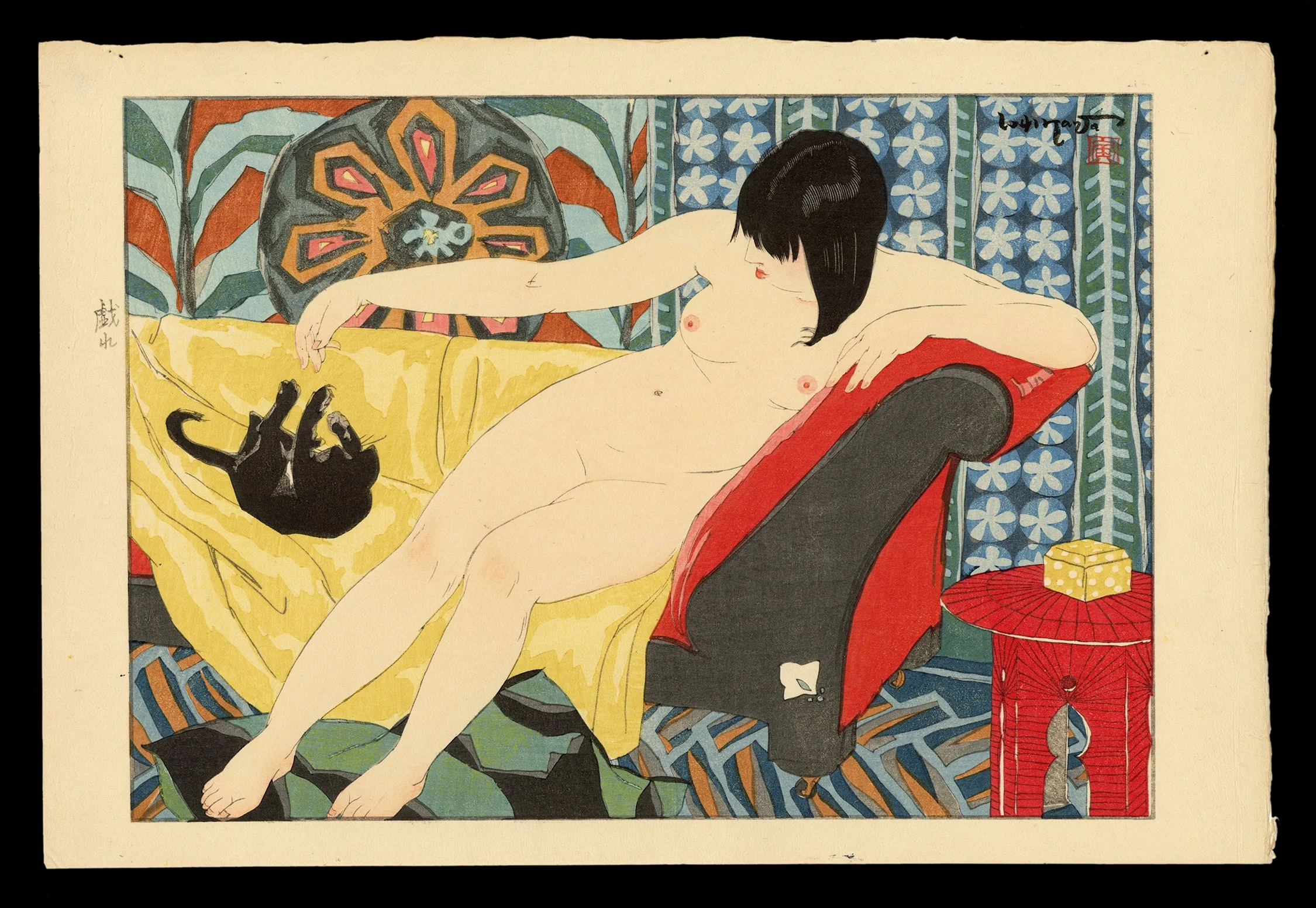
Ishikawa Toraji’s Playing presents an extraordinarily modern vision of intimacy and leisure during the final years of prewar Japanese cosmopolitan culture. Reclining nude across a boldly upholstered chaise longue, a young woman extends her hand playfully toward a black cat twisting upward beside her. Her sleek bobbed hairstyle falls partially across her face, obscuring one eye and heightening the sense of cultivated detachment that permeates the composition. Surrounding her are richly patterned textiles, decorative furnishings, and intensely saturated colors that transform the interior into a highly stylized world of sensual comfort and theatrical modernity.
The print reflects the sophisticated urban interiors that increasingly appeared within Japanese visual culture during the 1920s and 1930s, when department stores, imported furnishings, magazines, cinema, and international decorative trends reshaped ideals of modern domestic life. Toraji’s figure embodies the refined independence associated with the moga, the modern girl whose identity was defined not only through fashion and nightlife, but through leisure itself. Here, the nude body is not idealized through classical conventions, nor framed through overt eroticism. Instead, the figure appears relaxed and psychologically self-contained, absorbed in a private moment of amusement with the cat rather than consciously presenting herself to the viewer.
The decorative structure of the composition reveals Toraji’s remarkable engagement with Art Deco aesthetics and modern interior design. Flattened planes of vivid color, geometric textile patterns, and stylized furnishings create a rhythmic visual field that balances abstraction with intimacy. The striking red and black chaise longue anchors the figure dramatically against the patterned backdrop, while the playful movement of the cat introduces spontaneity into the otherwise carefully orchestrated arrangement. The result is both ornamental and deeply atmospheric, evoking the cultivated interiors associated with modern urban sophistication during the early Shōwa period.
Created in 1936, Playing emerged during a moment when Japanese society was becoming increasingly nationalistic and socially restrictive. Images celebrating modern leisure, bodily freedom, and private sensuality occupied an increasingly precarious position within official cultural discourse. Toraji’s print preserves a world still fascinated by cosmopolitan elegance and individual pleasure, even as the broader political atmosphere grew progressively more severe. This tension gives the image a subtle poignancy beneath its decorative brilliance.
Connoisseur's Note
Among Ishikawa Toraji’s modern figure compositions, Playing stands out for its extraordinary fusion of decorative modernism and psychological intimacy. The print demonstrates Toraji’s mastery of compositional balance, transforming an interior scene into a sophisticated interplay of pattern, contour, and emotional restraint. Every visual element contributes to the composition’s rhythmic harmony: the angular geometry of the furnishings, the fluid curve of the reclining body, the soft movement of the cat, and the repeating floral motifs surrounding the figure.
The work belongs to a broader international fascination during the 1930s with modern interiors as spaces of identity, pleasure, and self-fashioning. Across Europe, America, and Japan, artists increasingly explored private domestic environments populated by fashionable women, decorative objects, and exoticized furnishings. Toraji’s interpretation remains uniquely restrained despite its sensuality. The atmosphere is one of cultivated quiet rather than theatrical decadence, allowing mood and gesture to carry the emotional complexity of the image.
Collectors particularly prize works such as Playing because they reveal the full sophistication of Japanese modernist printmaking beyond more familiar landscapes and bijin-ga traditions. Toraji absorbs the influence of Art Deco design, modern fashion illustration, and international interior aesthetics while preserving the clarity and compositional discipline of Japanese woodblock technique. The layered textile patterns and carefully calibrated color relationships reveal an artist deeply attentive to both decorative harmony and emotional nuance.
The presence of the black cat adds a particularly compelling dimension to the composition. Long associated with sensuality, independence, and mystery within modern art, the animal functions here almost as an extension of the figure herself—playful, elusive, and emotionally self-contained. Their interaction softens the otherwise highly stylized environment, introducing warmth and spontaneity into the composition. Seen today, Playing preserves a fleeting atmosphere of modern urban elegance before the cultural transformations of the wartime years, offering a rare vision of leisure, intimacy, and quiet sophistication suspended delicately within the decorative world of early Shōwa modernism.
More prints by Ishikawa Toraji:
1934
$3,000
Youth
Ishikawa Toraji (1875–1964)
SERIES: Ten Types of Female Nudes
MEDIUM: Woodblock print
DATE: 1934
DIMENSIONS: 19 ¼ x14 ¾ inches
CONDITION: Excellent; no problems to note
LITERATURE: The Female Image, pl. 242
NOTE: First state; accompanied with a keyblock proof; silver mica background
$3,000.00