

 Image 1 of 1
Details
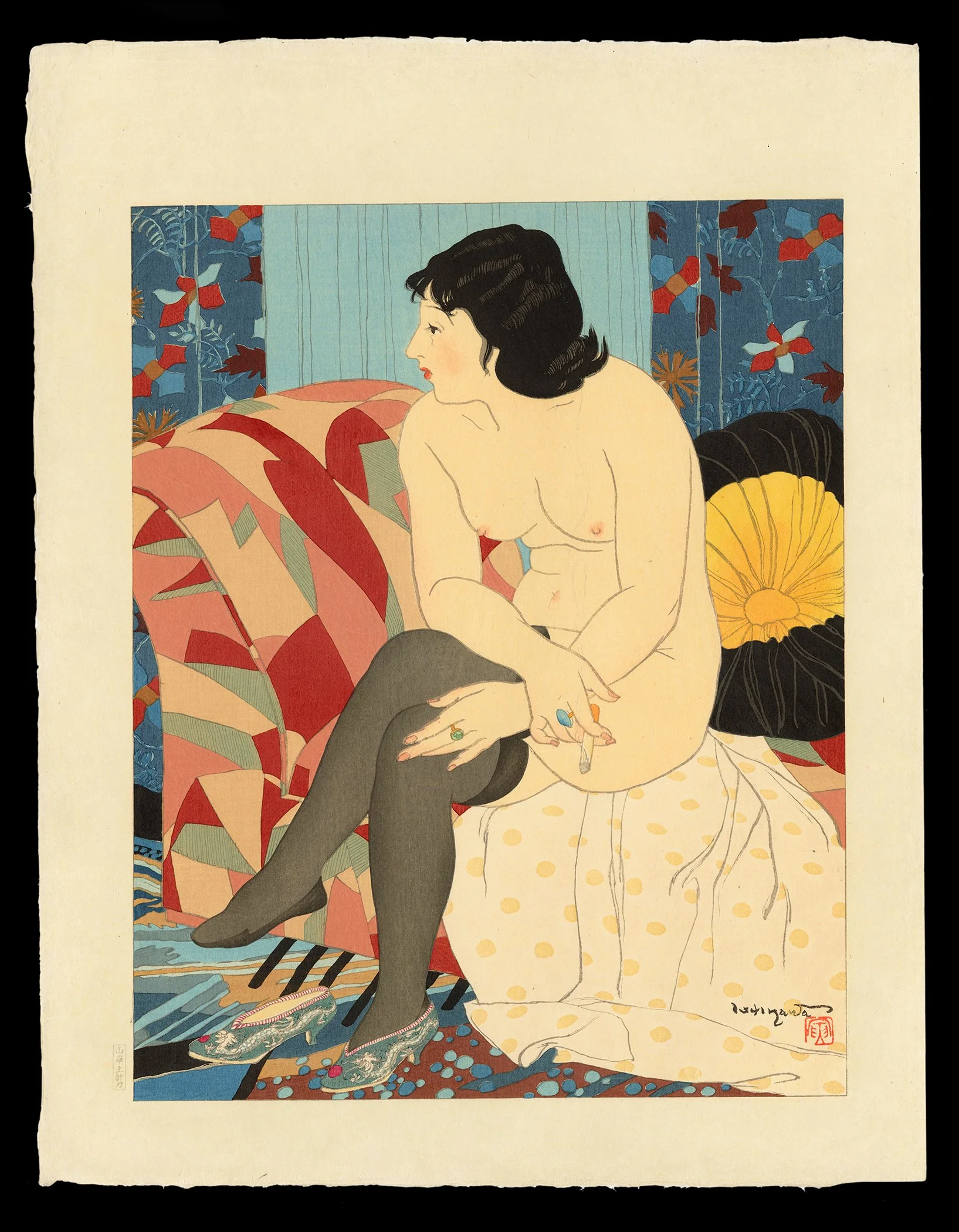
Ishikawa Toraji’s Relaxing is among the most provocative and psychologically nuanced images produced in Japanese printmaking during the early Shōwa period. A nude woman reclines casually amid richly patterned textiles, one black silk stocking still drawn elegantly over her leg while embroidered slippers rest nearby. In her lowered hand she loosely holds a lit cigarette, its presence subtle yet essential to the atmosphere of the composition. Her body turns gently away from the viewer as she gazes toward an unseen presence beyond the frame, creating a mood of cultivated intimacy infused with modern sophistication and emotional ambiguity.
The cigarette immediately situates the figure within the world of the moga, the modern girl whose image became synonymous with urban leisure culture during the 1920s and 1930s. Smoking, alongside cosmetics, Western fashion, jazz cafés, and nightlife, emerged as a visible emblem of cosmopolitan independence among younger women in Tokyo and Osaka. Toraji captures this cultural transformation with remarkable sensitivity. The figure is not presented as theatrical spectacle or moral provocation, but as entirely self-possessed—comfortable within her own modern identity and detached from conventional expectations surrounding femininity and decorum.
Visually, the composition reveals Toraji’s extraordinary synthesis of Japanese woodblock technique and contemporary international aesthetics. The flattened decorative surfaces and carefully orchestrated color harmonies reflect the influence of Art Deco design, while the intimate interior recalls the sensual domestic spaces explored by European modernist painters and illustrators during the same period. The geometric textiles and layered patterns create a rhythmic visual structure that contrasts elegantly with the softness of the body itself. Against this decorative richness, the cigarette introduces a fleeting gesture of movement and temporality, its ember quietly punctuating the stillness of the scene.
The print emerged during a period of intensifying political conservatism and cultural control within Japan. By 1934, state censorship had become increasingly aggressive toward works perceived as morally subversive or excessively Westernized. Relaxing became one of the most famous casualties of this atmosphere. Shortly after publication, the image was banned by government censors, and all unsold impressions together with the original woodblocks were confiscated and destroyed. The work’s combination of nudity, smoking, and unapologetically modern femininity challenged the tightening moral climate of the period, making surviving impressions extraordinarily rare today.
Connoisseur's Note
Among Ishikawa Toraji’s modern figure compositions, Relaxing occupies an almost legendary position. Its rarity alone would secure its significance, yet the work’s enduring power lies equally in its remarkable emotional and visual sophistication. Toraji approaches the female nude not through academic idealization or overt eroticism, but through atmosphere and psychological restraint. The woman’s partially dressed state, combined with the casually held cigarette, suggests a private moment unfolding naturally rather than a staged performance for the viewer.
The print belongs to a broader international movement during the late 1920s and early 1930s in which artists across Europe, America, and Japan increasingly explored the modern female interior as a site of autonomy, pleasure, and self-fashioning. Images of women smoking became especially potent symbols of changing gender roles and urban modernity. In Toraji’s interpretation, however, the cigarette functions less as provocation than as emotional punctuation—a quiet gesture of contemplation and cultivated detachment within an atmosphere of modern luxury.
Collectors particularly prize Relaxing because it stands at the intersection of Japanese printmaking and international modernist aesthetics. The work shares affinities with Art Deco illustration, modern fashion imagery, and European interior portraiture while remaining deeply rooted in the discipline and refinement of Japanese woodblock design. The luminous flesh tones, sophisticated patterning, and extraordinary compositional balance reveal Toraji working at the height of his artistic powers.
The censorship history surrounding the print deepens its resonance considerably. That the Japanese government deemed the image dangerous enough to suppress reveals the extent to which representations of female independence and modern leisure had become politically charged during the 1930s. Seen today, Relaxing preserves a fleeting cultural atmosphere in which personal freedom, urban sophistication, and artistic experimentation briefly flourished before yielding to increasing national control. The lit cigarette held casually at the figure’s side becomes, in retrospect, more than a modern accessory—it becomes a quiet symbol of transience itself, glowing momentarily before vanishing into shadow.
More prints by Ishikawa Toraji:
1934
$3,000
Youth
Ishikawa Toraji (1875–1964)
SERIES: Ten Types of Female Nudes
MEDIUM: Woodblock print
DATE: 1934
DIMENSIONS: 19 ¼ x14 ¾ inches
CONDITION: Excellent; no problems to note
LITERATURE: The Female Image, pl. 242
NOTE: First state; accompanied with a keyblock proof; silver mica background
$3,000.00