

 Image 1 of 1
Details
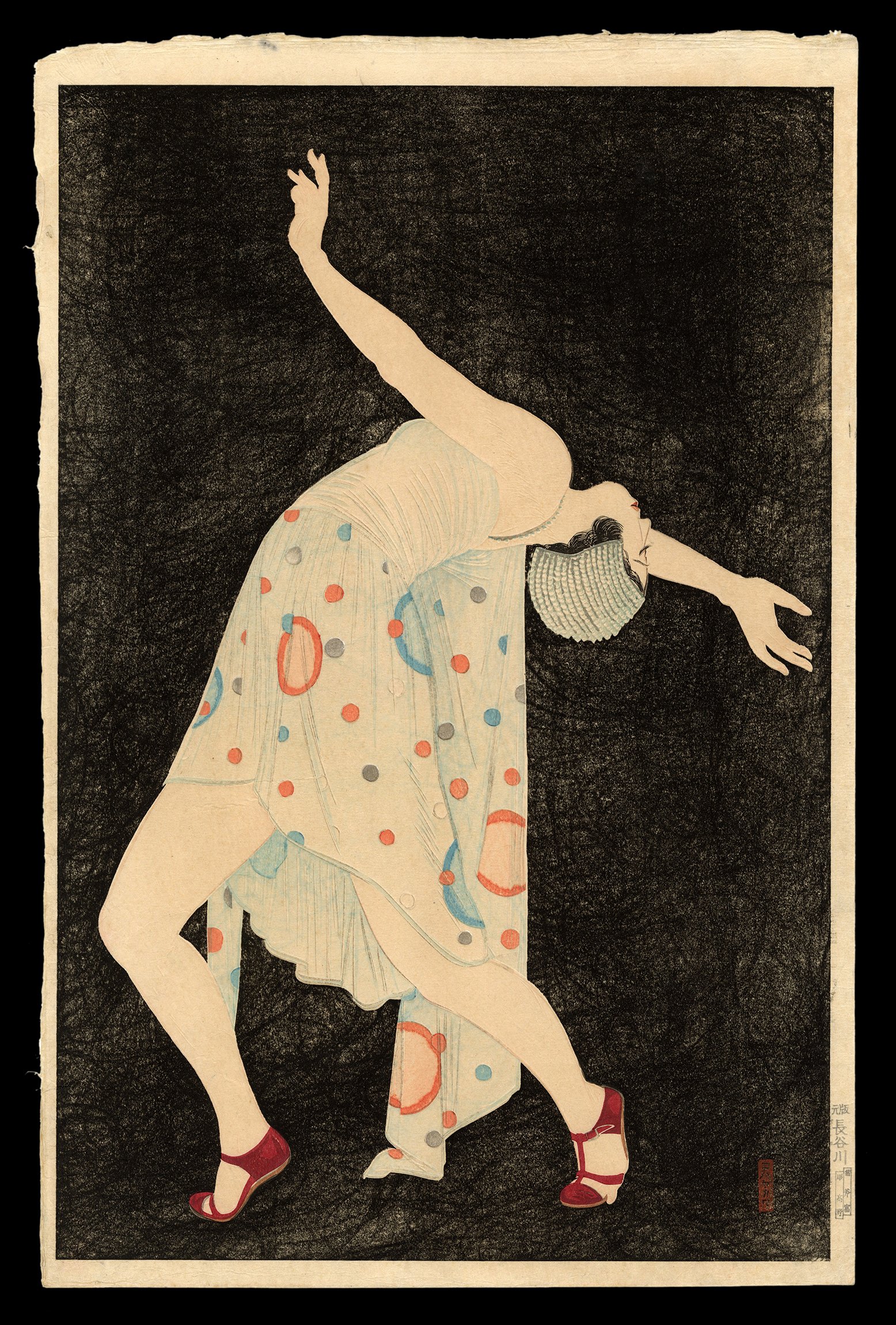
This standard edition of Kobayakawa Kiyoshi’s celebrated Dancer, sometimes referred to as Arch of the Instant, presents the design in its more commonly encountered printed form, distinguished by a textured, smoky black background rich with visible grain and tonal variation. Unlike the rare trial impressions printed with a dense, velvety solid black ground, this version possesses a softer and more atmospheric character, allowing the surface of the woodblock process itself to remain visible. The resulting effect introduces movement and depth into the surrounding darkness, giving the composition a distinctly more tactile and ephemeral quality.
The dancer herself remains one of the defining images of modern femininity produced during the early Shōwa period. Suspended in a dramatic backward arch, she stretches across the composition with extraordinary elasticity and control, her translucent patterned dress and crimson heels evoking the cosmopolitan nightlife culture flourishing in Tokyo and Osaka during the early 1930s. Jazz cafés, cabarets, dance halls, and revue theaters had become symbols of urban sophistication and Westernized leisure, offering new modes of self-expression shaped by imported music, fashion, and choreography. Kiyoshi’s distilled these cultural shifts into a radically simplified visual language of rhythm, gesture, and silhouette.
In this standard impression, however, the textured darkness surrounding the dancer alters the emotional tenor of the image considerably. Rather than isolating the figure within an uncompromising void, the smoky surface envelops her in an atmosphere suggestive of dim cabaret interiors, cigarette haze, or fading stage light. The dancer appears less monumental than in the rare solid-black trial impressions and more fleeting, as though emerging momentarily from shadow before dissolving back into it. The visible grain and uneven saturation of the printed ground soften the graphic severity of the design while heightening its sense of immediacy and transience.
Kiyoshi’s sensitivity to fleeting physical detail remains extraordinary throughout. Most memorable is the tiny toe slipping free from the dancer’s shoe, a subtle imperfection that humanizes the otherwise highly stylized composition. This small detail introduces a remarkable sensation of spontaneity and movement, suggesting a body so fully absorbed in performance that elegance momentarily gives way to physical reality. Such observational nuance gives the print its enduring vitality.
Connoisseur's Note
Among Kobayakawa Kiyoshi’s depictions of Western-style dance, Dancer remains his most sought-after and successful design, admired for its daring compositional reduction and extraordinary sense of motion. The image captures the fascination with modern dance culture that swept urban Japan during the early 1930s, when jazz rhythms, imported fashions, and cosmopolitan entertainment transformed the visual and social atmosphere of the modern city. Yet Kiyoshi’s achievement lies not merely in documenting this phenomenon, but in distilling it into a near-abstract arrangement of body, gesture, and space.
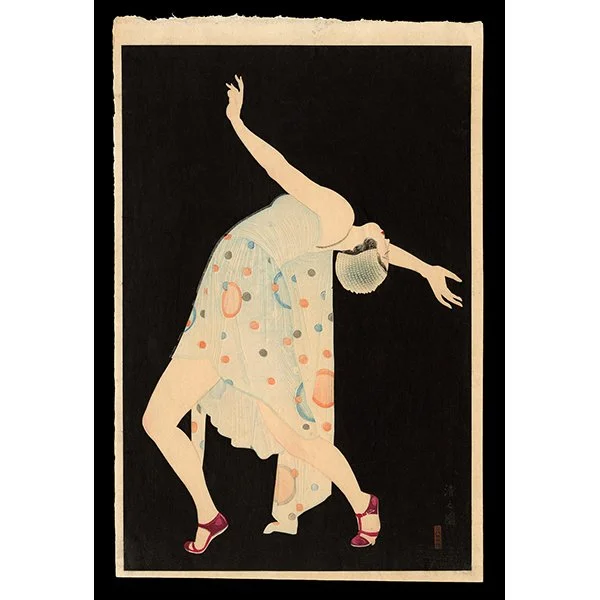
This standard printed version offers a markedly different emotional experience from the rare trial impressions featuring a flat, saturated black background. In those uncommon variants, the dancer appears sharply isolated, almost sculptural against the absolute darkness. Here, by contrast, the textured field introduces softness and atmosphere, emphasizing mood over graphic confrontation. The visible woodgrain and irregular printing deepen the sense of movement and impermanence, reminding the viewer of the handmade nature of the woodblock medium itself.
The print also reflects the cultural tensions of Japan during the early 1930s. Western dance represented liberation, sophistication, and modern urban pleasure, yet these same qualities increasingly existed in tension with rising nationalism and growing social conservatism. Kiyoshi’s captures this unstable atmosphere subtly rather than directly. The dancer’s poised freedom feels exhilarating but fragile, suspended within a world whose elegance already carries the shadow of disappearance.
Collectors have long prized impressions such as this for their atmospheric richness and material complexity. The textured black ground transforms the composition from pure graphic design into something more sensory and elusive. Every detail emerges with heightened poignancy: the pale curve of the dancer’s arms, the translucence of the dress, the gleam of crimson shoes, and above all, the tiny exposed toe slipping from its sandal at the height of motion. It is this fleeting imperfection—brief, human, and entirely unforced—that gives the image its lasting emotional power.
More prints by Kobayakawa Kiyoshi:

1932
$20,000
Odori
Kobayakawa Kiyoshi (1899–1948)
MEDIUM: Woodblock print
DATE: 1932
EDITION: 33/100
DIMENSIONS: 17 ¾ x 12 ¾ inches
CONDITION: Excellent; no problems to note
NOTE: Silver Mica Background; limited edition numeration on reverse
LITERATURE: The Female Image, pl. 196
$20,000.00