

 Image 1 of 1
Details
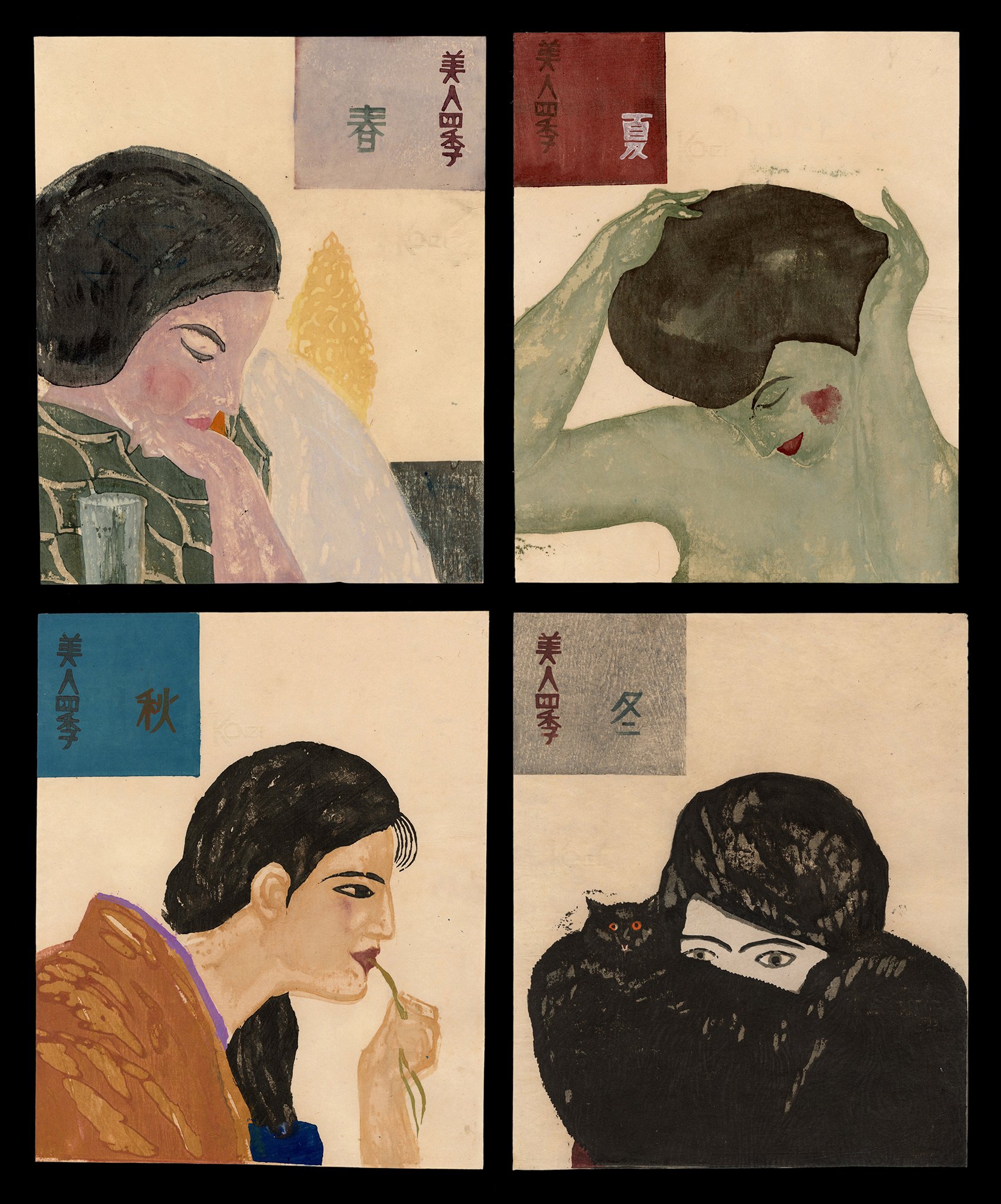
Koshiro Onchi’s Beauties of the Four Seasons stands among the most refined and psychologically evocative bijin-ga series produced within early Sosaku Hanga. Rather than presenting idealized beauties in conventional settings, Onchi isolates each female figure within a sparse and nearly abstract field, allowing gesture, color, and emotional atmosphere to become the central subjects. The women appear modern not simply in hairstyle or fashion, but in their introspective autonomy. Their expressions suggest inward contemplation rather than performance, reflecting the increasingly visible presence of women within the shifting cultural life of urban Japan during the early Showa era.
Each design compresses an entire seasonal mood into a radically economical arrangement. Autumn presents a sharply profiled woman tasting a trailing stem with detached elegance, her abbreviated form floating against empty paper like a passing thought. Spring lowers its figure into a moment of private reverie beside a delicate glass, evoking the subdued melancholy of café culture and fleeting encounters. In Summer, the pale bluish-green body dissolves into liquid tonalities as the figure gathers her dark hair, transforming the body itself into a seasonal atmosphere of heat and humidity. Winter, perhaps the most haunting of the group, encloses its subject within a dense black fur wrap interrupted only by wide eyes and the uncanny stare of a black cat peering outward from the darkness.
The elimination of the earlier French titles from the 1927 edition fundamentally alters the tone of the series. While the original version projected cosmopolitan sophistication aligned with international Art Deco sensibilities, this 1930 reworking feels quieter, more distilled, and more inwardly Japanese in conception. The simplified inscriptions and expansive negative space intensify the emotional ambiguity of the images, allowing the women to exist as embodiments of mood, season, and modern psychological identity rather than decorative fashion types alone.
Connoisseur's Note
The present set is an especially rare self-printed example produced directly by Onchi during the second state of the series in 1930. The production history of Beauties of the Four Seasons reveals a significant evolution in both artistic intention and material character. The first edition of 1927 included French titles and reflected the cosmopolitan graphic culture of the late Taisho and early Showa periods. This revised 1930 version removed those French elements to foreground the Japanese seasonal titles alone. A later third state issued by Nippon Hanga transformed the designs into commercially published machine-printed impressions intended for broader distribution.
These impressions preserve the qualities most closely associated with Onchi’s personal printing process. Their surfaces reveal irregular pigment absorption, softened contours, and fluid tonal transitions that convey the tactile immediacy of hand-rubbed printing. The effect resembles watercolor washes or wet ink spreading across paper, emphasizing spontaneity over mechanical precision. This distinction is especially visible in the Summer design, where the figure’s body appears in a pale green-blue tonality rather than the cooler gray coloration associated with the later machine-printed edition. Such variations are critical indicators of the self-printed state and underscore Onchi’s belief that each impression could function as a unique expressive object rather than a standardized reproduction.
Within the history of modern Japanese printmaking, this series occupies a pivotal position between traditional bijin-ga imagery and modern psychological portraiture. Onchi strips away anecdotal narrative and replaces it with atmosphere, emotional suggestion, and graphic abstraction. The women of the series are elusive figures suspended between intimacy and distance, their silence mirroring the cultivated ambiguity of metropolitan life during the early Showa era.
More prints by Koshiro Onchi:
1938
$3,000
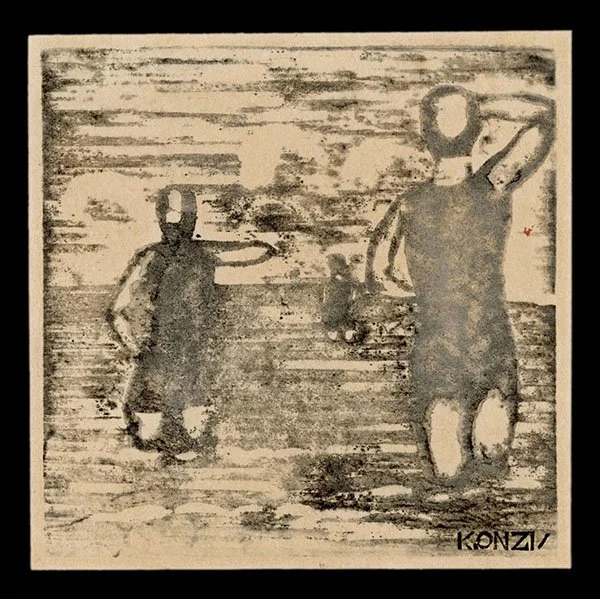
Yuigahama Beach, Kamaura
Koshiro Onchi (1891–1955)
SERIES: New 100 Scenic Views of Japan
MEDIUM: Woodblock print
DATE: 1938
DIMENSIONS: 9 x 12 ¼ inches
CONDITION: Excellent, no problems to note
$3,000.00