

 Image 1 of 1
Details
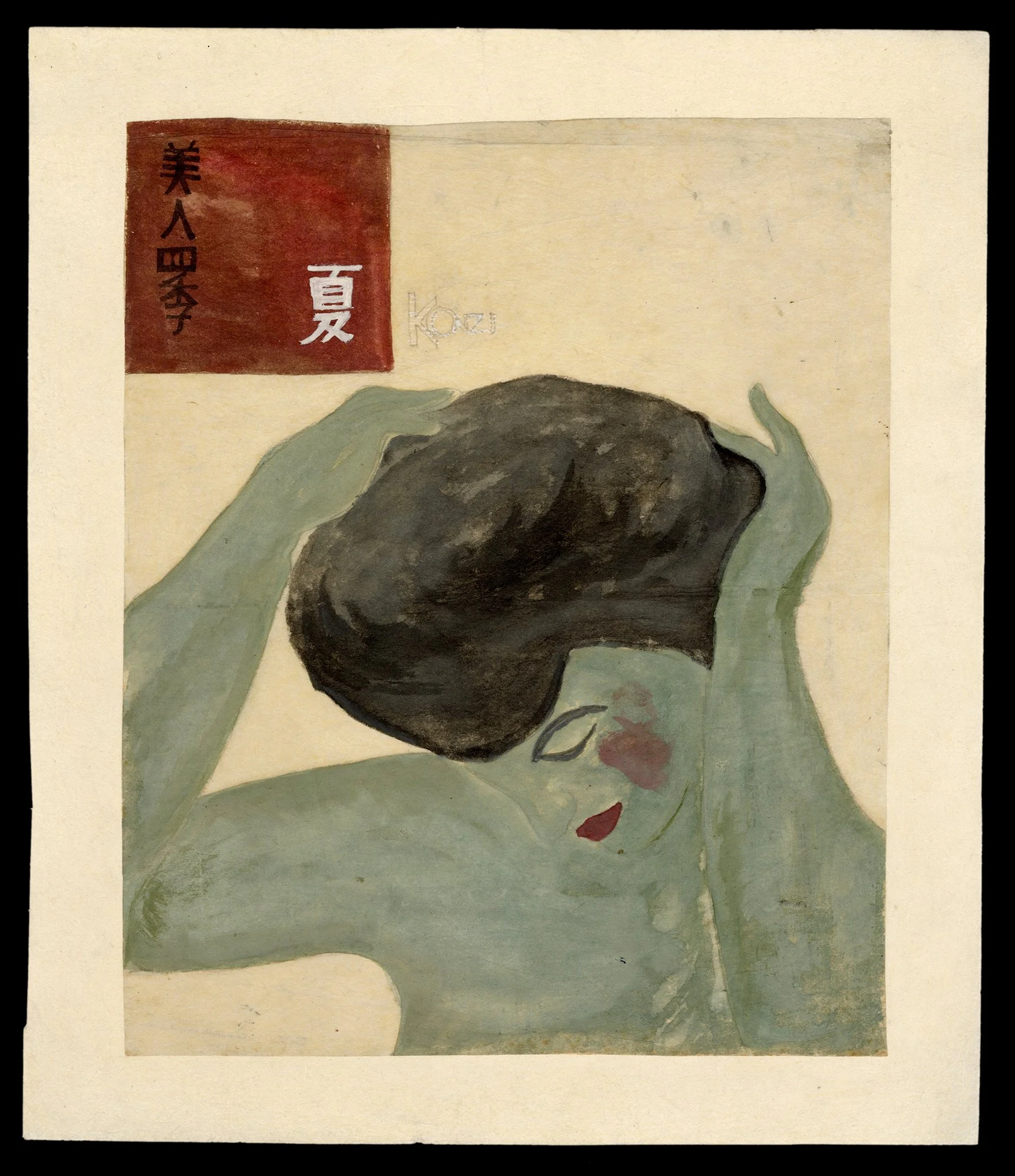
This original painting was created as a preparatory study for Onchi Kōshirō’s redesigned version of his celebrated Shiki (“Four Seasons”) series. The first edition of the series, issued in 1927, incorporated French titles, reflecting the cosmopolitan visual culture that permeated Tokyo during the late Taishō and early Shōwa periods. European graphic design, modern typography, imported magazines, and café culture shaped the aesthetic language of the city’s artistic circles, and the original Shiki set emerged directly from this sophisticated urban environment.
By 1930, however, Onchi revisited the series and produced a reworked version using exclusively Japanese text. Before carving the revised blocks, he prepared a number of original painted studies to refine the tonal relationships and compositional balance of the final designs. The present work represents the study for Summer within that revised cycle. More than a technical exercise, the painting reveals the artist searching for emotional equilibrium within the composition itself. Soft veils of green drift across the surface while forms remain partially unresolved, allowing the image to retain the immediacy of experimentation and revision.
The composition possesses an extraordinary atmospheric restraint. Rather than depicting a specific location or narrative moment, Onchi constructs an emotional climate through color and spatial rhythm. The muted luminosity of the green palette suggests the dense stillness of summer air, while the softened contours evoke fleeting impressions rather than fixed forms. Such ambiguity reflects the increasingly introspective direction of Onchi’s art during the interwar years, when many artists associated with modern Tokyo sought new visual languages capable of expressing the psychological complexities of contemporary urban life.
The painting also demonstrates Onchi’s movement toward abstraction as a deeply personal mode of expression. Unlike many contemporaneous printmakers working within commercially driven shin hanga production, Onchi pursued a quieter and more experimental visual vocabulary rooted in mood, memory, and subjective experience. In this preparatory study, one witnesses the transitional space between conception and completion — the moment in which atmosphere first begins to crystallize into formal structure.
Connoisseur's Note
Preparatory paintings related to major Sosaku Hanga works are exceptionally scarce, particularly those connected to Onchi’s most celebrated serial designs. The present study offers rare insight into the artist’s working methodology at a moment when he was refining both the visual and conceptual direction of the revised Shiki set. Because these paintings were functional studio objects rather than commercial works intended for sale, comparatively few survived, making examples of this quality especially significant to collectors and scholars of twentieth-century Japanese printmaking.
The work gains additional importance when considered alongside the later third state of the Shiki series issued by the publisher Nippon Hanga. Although based upon Onchi’s redesigned Japanese-language compositions, the later edition was mechanically printed and lacks the nuanced surface modulation characteristic of Onchi’s own hand-pulled impressions. In the Nippon Hanga version of Summer, the coloration shifts toward a cool gray tonality, flattening much of the atmospheric depth present in both this original painting and the self-printed 1930 edition. The contrast demonstrates how essential color calibration and printing technique were to Onchi’s artistic intentions. His carefully controlled greens were not merely decorative choices, but integral components of the emotional structure of the composition.
Equally compelling is the painting’s physical intimacy. One senses the artist’s hand directly in the layering of pigment and the subtle adjustments within the forms — qualities inevitably softened in the translation to printed media. These traces of revision allow the viewer to encounter the work not as a finalized image alone, but as evidence of artistic decision-making in progress. Such immediacy gives the study a vitality distinct from the completed print and positions it as an independent work of considerable aesthetic and historical importance.
More prints by Koshiro Onchi:
1938
$3,000
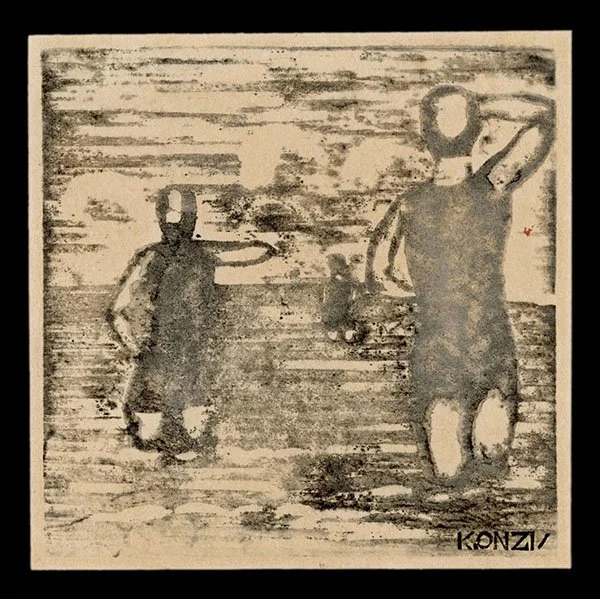
Yuigahama Beach, Kamaura
Koshiro Onchi (1891–1955)
SERIES: New 100 Scenic Views of Japan
MEDIUM: Woodblock print
DATE: 1938
DIMENSIONS: 9 x 12 ¼ inches
CONDITION: Excellent, no problems to note
$3,000.00