

 Image 1 of 1
Details
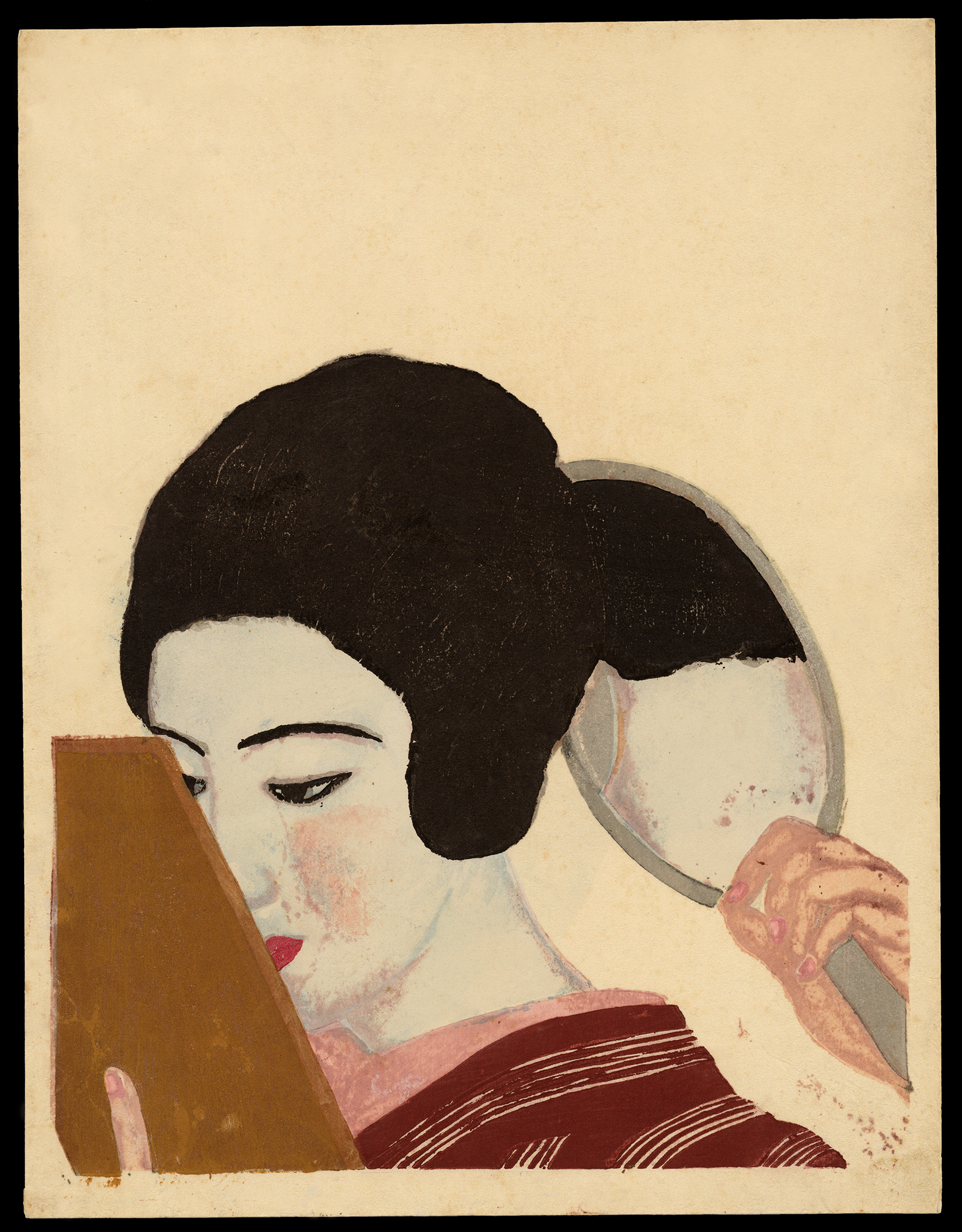
Created around 1929–1930, Mirror belongs to a period in which Onchi Kōshirō explored the possibilities of figural imagery with increasing sophistication. While he remained deeply committed to abstraction and experimental printmaking, Onchi also produced a small body of representational works that merged modern subject matter with highly distilled compositional design. In Mirror, he transforms an ordinary act of grooming into a carefully orchestrated study of line, silhouette, and spatial balance.
The composition depicts a woman examining herself with the aid of two mirrors, one held behind her by an unseen attendant. This secondary reflection reveals the nape of her neck and the sculptural precision of her modern coiffure, introducing a subtle complexity to the otherwise restrained composition. Onchi reduces the scene to essential visual elements: sharply contoured black hair, pale expanses of skin, and carefully measured intervals of unprinted paper. The resulting image possesses remarkable clarity and restraint, allowing the viewer’s attention to move rhythmically across the surface.
The subject reflects the changing visual culture of urban Japan during the interwar years. Short hairstyles, cosmetics, and ritualized self-presentation became increasingly associated with the modern woman as department stores, cafés, beauty salons, and cinema culture reshaped metropolitan life. Yet Onchi avoids treating the figure as fashionable spectacle alone. The woman appears absorbed in a private moment of concentration, creating an atmosphere of introspection rather than performance. Her downward gaze and composed posture lend the print an emotional stillness that contrasts subtly with the sophistication of her appearance.
Particularly notable is Onchi’s handling of surface and texture. Delicate embossing and carefully controlled printing effects create variations of light across the composition, softening the stark geometry of the design. The tactile richness of the print reveals the artist’s deep sensitivity to material process and demonstrates the extent to which printing technique itself functioned as an expressive component of the image.
Connoisseur's Note
Mirror occupies a distinctive place within Onchi’s broader contribution to Sosaku Hanga because it demonstrates how effectively he adapted traditional bijin-ga themes to the visual language of modernism. Images of women before mirrors had long appeared within Japanese art, but Onchi strips away anecdotal detail and decorative excess, replacing them with compositional severity and psychological nuance. The result is neither conventional beauty print nor pure abstraction, but something suspended between the two.
Equally compelling is the print’s relationship to contemporary graphic design. The asymmetrical cropping, flattened forms, and dramatic use of negative space reveal affinities with international Art Deco aesthetics and avant-garde illustration of the late 1920s. At the same time, the composition remains unmistakably personal in tone. Rather than celebrating glamour outright, Onchi introduces a subtle emotional distance that complicates the image’s elegance. The mirror becomes less an object of vanity than a device for fragmentation and self-observation.
Collectors particularly value impressions of Mirror that preserve the artist’s original printing effects. Because Onchi approached printmaking as an extension of personal artistic expression rather than reproductive craft, his self-printed impressions possess extraordinary sensitivity in pigment density, embossing, and paper surface. These qualities are often diminished or lost in later reproductions, making strong early impressions especially desirable.
The print also reveals the extent to which Onchi helped redefine modern Japanese printmaking during the interwar era. By combining contemporary subject matter with radical simplification and materially sophisticated printing techniques, he expanded the expressive possibilities of the woodblock medium beyond both traditional ukiyo-e conventions and commercially oriented Shin Hanga production.
More prints by Koshiro Onchi:
1938
$3,000
Yuigahama Beach, Kamaura
Koshiro Onchi (1891–1955)
SERIES: New 100 Scenic Views of Japan
MEDIUM: Woodblock print
DATE: 1938
DIMENSIONS: 9 x 12 ¼ inches
CONDITION: Excellent, no problems to note
$3,000.00