

 Image 1 of 1
Details
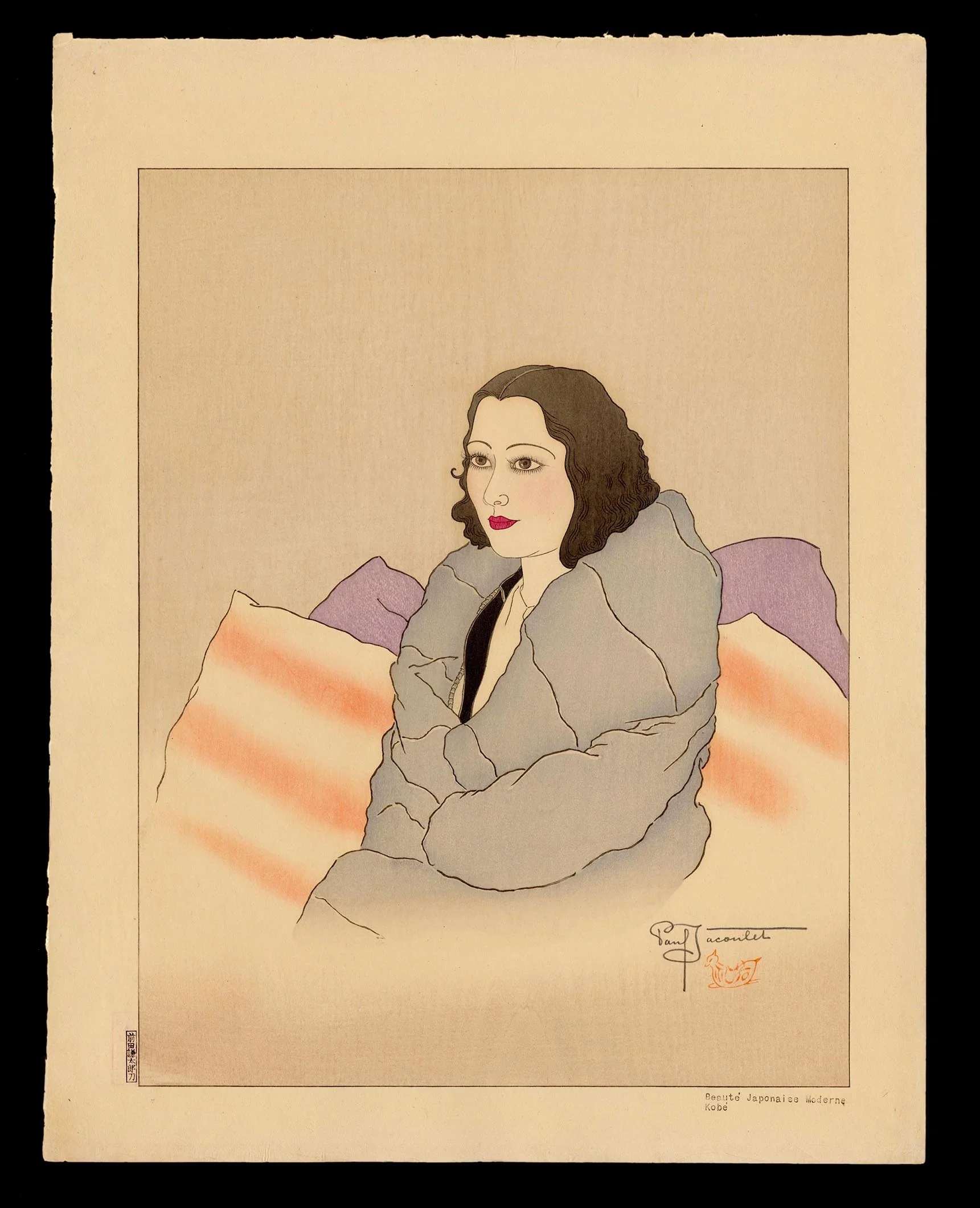
Paul Jacoulet’s Beauté Japonaise Moderne (Kobe) presents a sophisticated portrait of modern Japanese femininity shaped by the cosmopolitan atmosphere of 1930s Kobe. The elegantly dressed woman appears enveloped in a luxurious pale fur coat, her softly waved bobbed hair and carefully applied cosmetics reflecting the influence of European fashion and urban modernity that had become deeply embedded within Japan’s port cities during the early Shōwa period. Her poised expression and understated glamour embody the cultivated refinement associated with the modern woman of Kobe, a city whose international character distinguished it sharply from much of Japan during the years between the late 1920s and mid-1930s.
As one of Japan’s principal international ports, Kobe became a center of foreign trade, expatriate culture, Western fashion, and continental sophistication. European architecture, imported luxury goods, jazz cafés, and international social circles shaped the visual identity of the city and profoundly influenced local ideals of style and elegance. Jacoulet’s sitter reflects this atmosphere perfectly. Though unmistakably Japanese, her appearance reveals the cosmopolitan sensibilities of a generation increasingly attuned to Parisian couture, Hollywood cinema, department store fashion, and global modern culture. In this sense, the figure exists firmly within the world of the moga, whose identity emerged through the blending of Japanese and international aesthetics.
Jacoulet himself was uniquely positioned to interpret such subjects. Born in France yet raised primarily in Japan, he developed a highly personal artistic language that fused Japanese woodblock technique with international modernism and Art Deco refinement. Renowned for producing some of the most technically ambitious woodblock prints ever created, Jacoulet frequently utilized extraordinarily complex printing processes involving dozens—and in some cases over one hundred—individual woodblocks to achieve subtle tonal transitions and luxurious surface effects. In Beauté Japonaise Moderne (Kobe), these technical accomplishments are visible in the soft atmospheric gradations surrounding the figure, the tactile rendering of the fur coat, and the delicate modeling of the sitter’s face.
The composition is striking for its restraint. Vast passages of softly toned emptiness surround the figure, allowing her presence to emerge with remarkable psychological clarity. The muted palette of pale mauves, warm creams, and soft grays creates an atmosphere of quiet elegance rather than theatrical glamour. Jacoulet transforms fashion portraiture into something contemplative and emotionally nuanced, preserving not simply the likeness of a fashionable woman, but the atmosphere of cosmopolitan modernity itself.
Connoisseur's Note
Beauté Japonaise Moderne (Kobe) stands among Jacoulet’s most refined explorations of Japanese modern identity during the early Shōwa period. Unlike many contemporary depictions of the moga that emphasized nightlife, jazz culture, or overt theatricality, Jacoulet approaches modern femininity through elegance, stillness, and psychological sophistication. The sitter’s composed gaze and enveloping fur coat project quiet confidence rather than overt display, reflecting the increasingly nuanced representations of women emerging within Japanese visual culture during the 1930s.
The work also reveals Jacoulet’s extraordinary sensitivity to regional identity within modern Japan. Kobe occupied a unique cultural position during this era, functioning as one of the country’s most visibly international cities. Foreign merchants, diplomats, artists, and travelers contributed to a cosmopolitan atmosphere that deeply influenced fashion and social life. The modern woman depicted here becomes not merely an individual portrait, but an embodiment of Kobe itself—a city shaped by international exchange, urban sophistication, and evolving conceptions of femininity.
Collectors particularly prize Jacoulet’s prints for their unmatched technical brilliance, and this work demonstrates the extraordinary refinement that distinguished his production from virtually all other twentieth-century woodblock artists. The subtle tonal gradations surrounding the figure, the delicate treatment of the lips and eyes, and the luxurious rendering of the fur reveal a level of craftsmanship that pushed Japanese printmaking to unprecedented technical heights. Jacoulet’s obsessive pursuit of perfection transformed the woodblock medium into one capable of rivaling the elegance of high-fashion illustration and luxury printmaking anywhere in the world.
Beyond its technical mastery, however, the print possesses remarkable emotional resonance. The sitter appears suspended within an atmosphere of cultivated silence, poised delicately between Japanese identity and international modernity. Seen today, Beauté Japonaise Moderne (Kobe) preserves the fragile glamour of prewar cosmopolitan Japan—a world of port cities, imported fashions, jazz cafés, and evolving social freedoms that would soon be overshadowed by the increasingly turbulent political climate of the later 1930s.
More prints by Paul Jacoulet:
1934
$25,000
Une Parisienne
Paul Jacoulet (1896–1960)
MEDIUM: Woodblock print
DATE: 1934
EDITION: Kanji edition, numbered /150 on reverse
DIMENSIONS: 19 x 14 inches
CONDITION: Exceedingly fine state of preservation with pristine vivid colors
NOTE: Accompanied with rarely seen tissue paper cover baring tittle
LITERATURE: Miles, pl. 6
$25,000.00