

 Image 1 of 1
Details
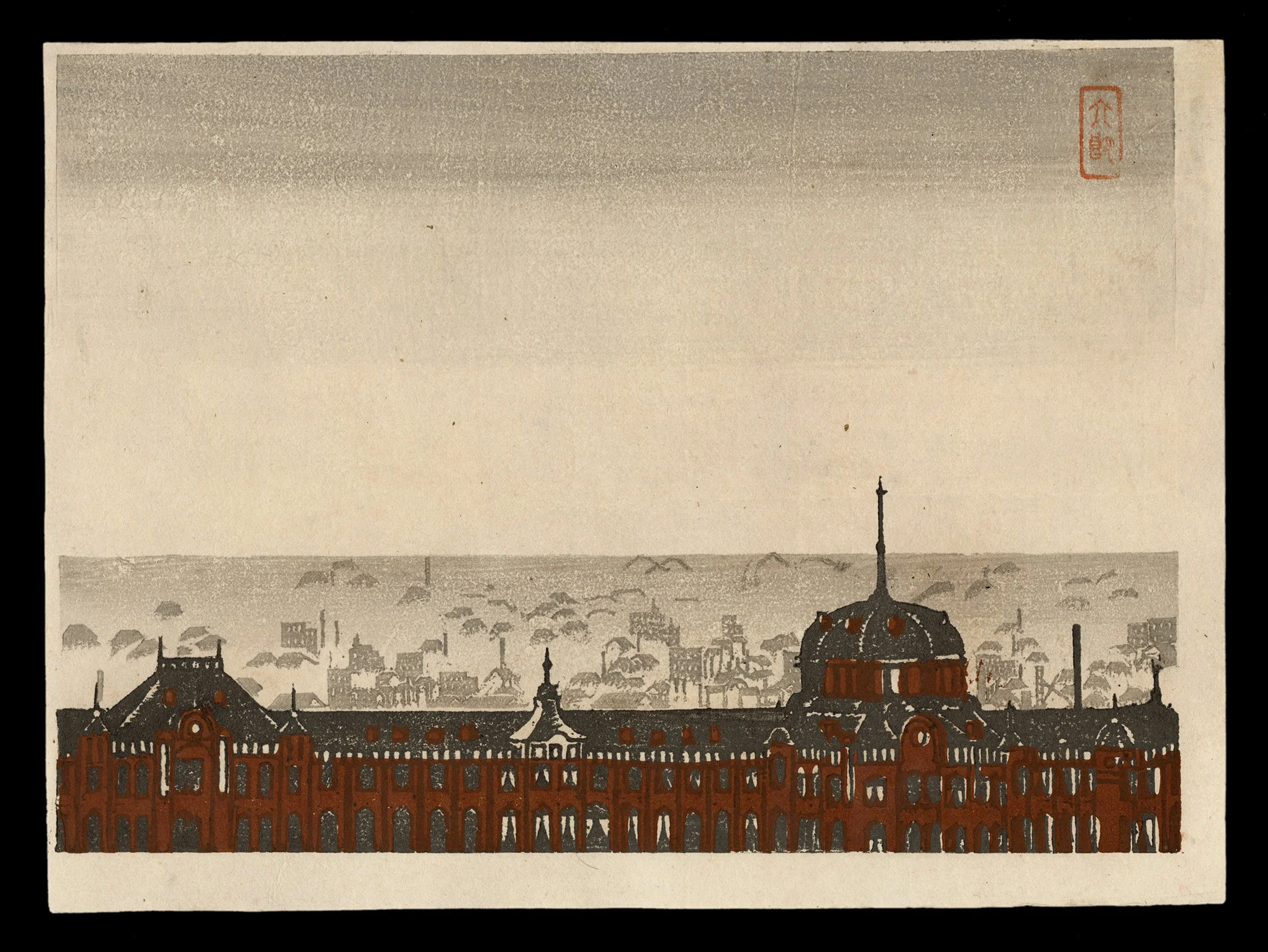
Muto Rokuro’s Tokyo Station presents one of the capital’s great architectural landmarks as an emblem of endurance and renewal. Completed in 1914 to the design of Tatsuno Kingo, the monumental red-brick station survived the Great Kantō Earthquake and fires of 1923 with relatively limited damage. By 1932, when Muto made this print, the building had become a powerful point of continuity within a city dramatically transformed by nearly a decade of reconstruction.
Muto emphasizes this idea through an unusually restrained composition. The long red-brick façade stretches almost uninterrupted across the lower portion of the sheet, its dark roofs, domes, towers, and central spire forming a rhythmic silhouette. Behind it, the rebuilt city dissolves into a delicate haze of pale gray buildings and rooftops. Above, an enormous expanse of nearly empty sky gives the station a quiet monumentality. The subdued gray and ochre palette makes the warm brick façade appear all the more substantial—as though the station itself were an anchor within the changing metropolis.
There is also a striking dialogue between old and new. Tokyo Station belonged architecturally to the first great phase of Japan’s modern transformation, yet here it stands before the expanding city of the early Shōwa period. Rather than celebrating reconstruction through skyscrapers or new infrastructure, Muto chose a structure that had endured the disaster and continued to serve the rebuilt capital. The image therefore becomes as much about continuity as modernization.
Connoisseur’s Note
This is a particularly evocative prewar image of Tokyo because its historical meaning is inseparable from its elegant formal simplicity. Muto reduces the immense station to a horizontal band of red brick and dark rooflines beneath an expansive, atmospheric sky, while the reconstructed city appears almost ghostlike in the distance.
For collectors of sōsaku hanga and prewar views of Tokyo, the print offers a compelling intersection of architecture and history. Made less than a decade after the Great Kantō Earthquake, it records Tokyo Station at a moment when the surviving landmark could be understood as a symbol of the capital’s resilience. Its distinctive panoramic composition, restrained palette, and important subject make it an especially appealing document of Tokyo’s remarkable passage from catastrophe to reconstruction. This impression carries the distinguished provenance of the Ono Tadashige Museum, adding further significance to an already uncommon work.
More prints by Rokuro Muto:
1932
RESERVED
Shinbashi Bridge
Rokuro Muto (1907-1995)
MEDIUM: Woodblock print
DATE: 1932
DIMENSIONS: 11 x 15 ½ inches
CONDITION: Excellent, no problems to note
PROVENANCE: Ono Tadashige Museum
$2,000.00 <RESERVED>