

 Image 1 of 1
Details
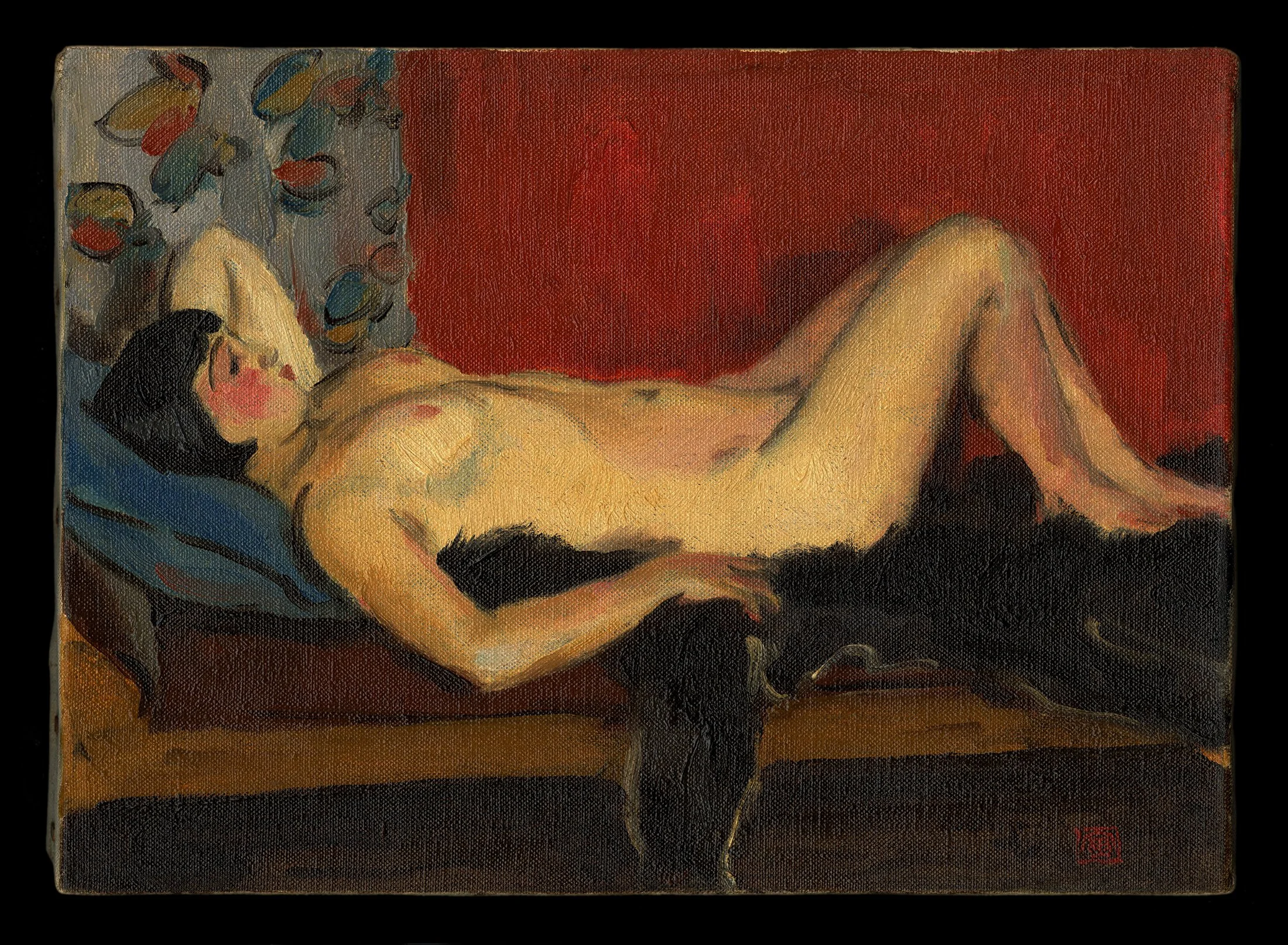
This intimate untitled oil painting by Ishikawa Toraji, here given the working title Moga Reclining, offers a rare and deeply atmospheric glimpse into the artist’s engagement with modern femininity beyond the medium of woodblock print. A nude young woman reclines across a chaise or divan, her elongated body stretched languidly against a field of warm vermilion and a fragment of floral wallpaper. Her sleek bobbed hair, softly rouged cheeks, and relaxed posture firmly situate her within the visual culture of the moga—the modern girl whose image came to embody urban sophistication and shifting social identity during the late 1920s and early 1930s.
Unlike the highly controlled decorative surfaces of Toraji’s woodblock designs, the painting possesses a striking immediacy and painterly looseness. Broad, tactile brushstrokes animate the flesh tones and surrounding textiles, while areas of exposed canvas and softly dissolved contours create an atmosphere of quiet intimacy. The artist allows the materiality of oil paint itself to remain visible throughout the composition. This gives the work a sensual warmth and emotional spontaneity absent from the more polished precision of printed media.
The composition reflects the influence of both European modernist painting and Japanese interpretations of Western-style oil painting (yōga) that flourished during the early Shōwa period. By approximately 1930, artists throughout Japan increasingly explored the female nude not merely as an academic exercise, but as a vehicle for psychological modernity and urban sophistication. Toraji’s figure does not appear mythological or allegorical; she exists instead within a recognizably contemporary domestic interior. The patterned wallpaper behind her and richly colored furnishings evoke the fashionable interiors associated with cosmopolitan middle-class life during the decade.
Her pose conveys neither overt seduction nor classical idealization. Rather, the painting captures a mood of cultivated indifference and physical ease characteristic of modern urban imagery during the period. The reclining body becomes less an object of display than an expression of interior atmosphere and private leisure. In this respect, the work resonates strongly with broader international depictions of modern women produced throughout Paris, Berlin, New York, and Tokyo during the years between the late 1920s and early 1930s, when artists increasingly turned toward intimate interiors and psychologically charged representations of femininity.
Connoisseur's Note
Paintings by Ishikawa Toraji remain considerably rarer on the market than his celebrated woodblock prints, making works such as Moga Reclining especially significant for collectors interested in the full breadth of the artist’s modernist practice. The painting reveals Toraji operating with remarkable freedom, liberated from the formal constraints of carved line and registered color planes. His brushwork here becomes fluid, exploratory, and deeply responsive to light and surface.
Particularly compelling is the artist’s handling of color relationships. The warm vermilion backdrop presses gently against the pale flesh tones, while passages of deep black fabric anchor the composition visually and emotionally. These tonal contrasts create a rhythmic tension between warmth and shadow that heightens the painting’s quiet sensuality. The decorative textile visible behind the sitter introduces an additional modern note, echoing the influence of Art Deco patterning and contemporary interior design that increasingly permeated Japanese urban culture during the period.
Viewed today, Moga Reclining preserves the atmosphere of a fleeting cosmopolitan moment within prewar Japan—a world shaped by café culture, modern fashion, imported aesthetics, and evolving perceptions of feminine identity. The painting’s intimacy feels remarkably contemporary even now. Rather than presenting the nude as spectacle, Toraji transforms the figure into a meditation on leisure, privacy, and emotional stillness within the changing rhythms of modern life.
More prints by Ishikawa Toraji:
1934
$3,000
Youth
Ishikawa Toraji (1875–1964)
SERIES: Ten Types of Female Nudes
MEDIUM: Woodblock print
DATE: 1934
DIMENSIONS: 19 ¼ x14 ¾ inches
CONDITION: Excellent; no problems to note
LITERATURE: The Female Image, pl. 242
NOTE: First state; accompanied with a keyblock proof; silver mica background
$3,000.00